By Melissa Lenczewski, Professor of Contaminant Hydrogeology, Northern Illinois University Department of Earth, Atmosphere and Environment, and Institute for the Study of the Environment, Sustainability and Energy
For World Water Day on March 22, we’re sharing a series of blog posts diving more deeply into this vital resource.
Dr. Lenczewski is a Fulbright ASEAN Research Scholar currently conducting water research in Cambodia funded by the Fulbright U.S.-ASEAN Visiting Scholar Initiative Program. In celebration of World Water Day, we asked her to share a bit about her research.
As the Earth is changing, so is our relationship to water. Whether for agriculture, industry or personal consumption, our current use of fresh water is unsustainable. In many parts of the world, especially the Southeast Asian country of Cambodia, access to clean, safe drinking water is unavailable. Climate change, difficulties in collaborating with neighboring countries and increasing populations will have significant impacts on groundwater quality and availability, with demand for water increasing dramatically in the coming decades.
Groundwater is the water that exists underground, in soil or in crevices or pores in rock. Groundwater cannot be seen. Therefore, it is often forgotten, leading to overexploitation or pollution from surface activities. Worldwide, 2.5 billion people rely solely on groundwater for drinking water. Agriculture uses groundwater, especially in times of drought or changing climate patterns, while industry uses groundwater for production of goods. Activities on the Earth’s surface, especially in urban, high population areas, can increase pollution, while in rural areas a lack of wastewater treatment threatens this resource. In addition, natural pollutants such as arsenic, fluoride or salt can be exacerbated by changing water use. Understanding the current and changing state of the quality of local groundwater resources can aid in planning for the future even with climate change.
Phnom Pehn, the capital city of Cambodia, is experiencing rapid growth and development with little regard to groundwater and surface water quality. Boeng Tompun and Cheung Ek wetland located south of the city is a large wastewater treatment wetland that services approximately 90% of the combined storm water and untreated municipal wastewater from the city. That’s right – the natural processes of these wetlands can actually filter out contaminants and improve water quality! Currently, nearly the entire wetland is being filled in to make room for more malls and high-rise buildings – which could be disastrous for water quality in the region.
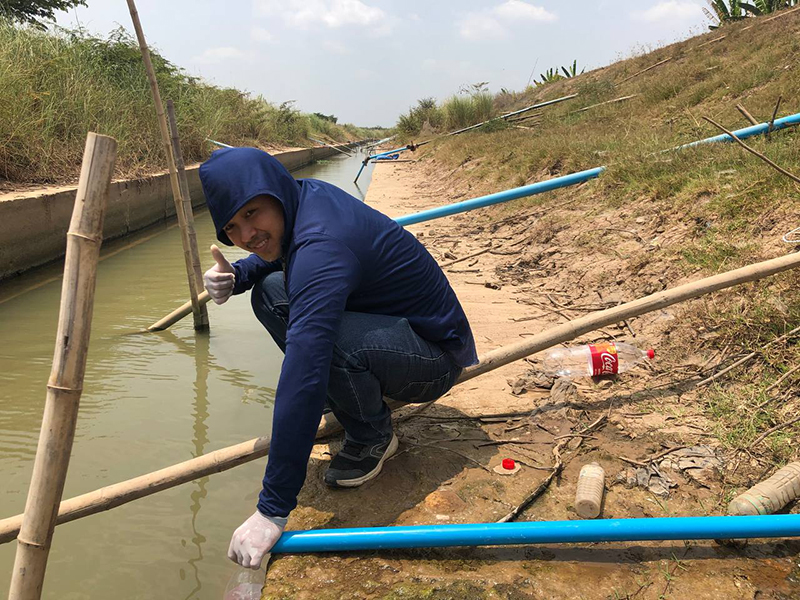
During my Fulbright to Cambodia, I have been working with two universities on water related issues. With the Royal University of Phnom Pehn (RUPP) we sampled groundwater and surface water in the Boeng Tompun region from where the raw sewage enters the lake to where it discharges into the Bassac River. Two students from RUPP who are majoring in Environmental Studies went with me to sample around the lake.
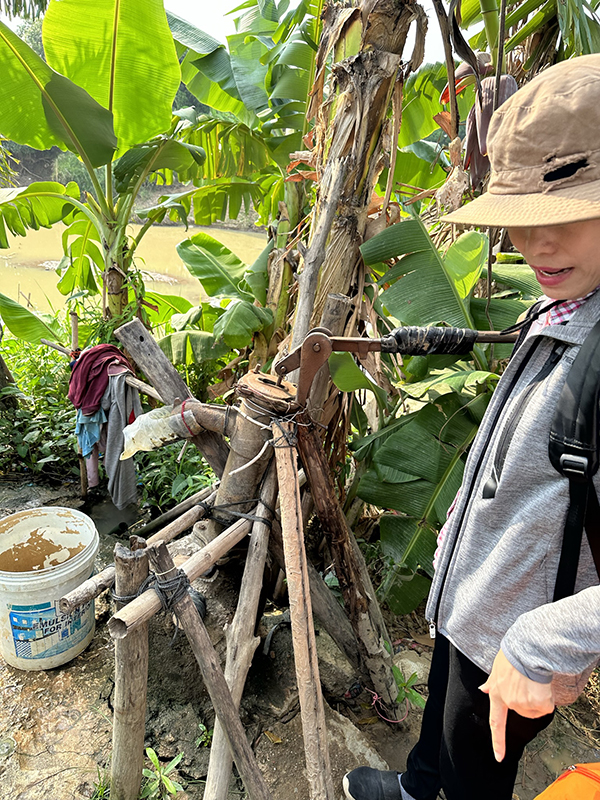
Another issue associated with development is changing water levels due to damming up the Mekong River. In a region called Koh Thom, irrigation canals bring river water to the important rice, mango, corn and banana fields. This region helps feeds the citizens of Phnom Pehn. With the new development, water resources and quality are changing, which will have a major impact on agriculture and food production. Researchers from Institute of Technology of Cambodia (ITC) examine groundwater from shallow and deep wells to determine changes to the geochemistry of the water – in other words, the chemical properties of the water. The deep wells are not currently used due to high iron and other noxious minerals in the water, but with decreases in the amount of water available to irrigate the fields, soon this water might be needed to help keep up food production and provide water for the farmers.
Cambodia is a beautiful country and has so much to offer the world. Water is important factor in the lives of all Khmer people. We hope that with a better understanding of the water cycle, the country will be able to thrive in a changing world.
For World Water Day on March 22, we’re sharing a series of blog posts diving more deeply into this vital resource.
Recently our NIU STEAM staff had the opportunity to participate in a learning experience about substance abuse and our youth. We were all very grateful for the timely and eye-opening information gathered from Northwestern Medicine professionals. One valuable and actionable takeaway that reminded me of one of our summer camps is the National Prescription Drug Take Back Day. This spring that day falls on April 22.
There are many of us that do not know the proper way to dispose of prescription medication or why. Flushing or throwing away your medications leeches them into our waterways, ground water and soil. To find out more about the effects this has on our wildlife, check out these articles: Pharmaceuticals in Wateror There’s Active Drugs in Our Drinking Water: What’s Being Done?.
How does this relate to the STEAM Seekers elementary day camp? We will be taking a field trip to one of NIU’s lagoons and gathering water samples to look at them under a microscope. We’ll ask: What do the students observe? What is present that they cannot see with the naked eye? Should they drink the water? Why or why not? How do they think what they see got in the water? Was it perhaps flushed down the toilet? To learn more about this and all of our NIU STEAM summer camps visit niusteamcamps.com.
If you’d like to start learning now, here are a few fun investigations to do with water at home.
If you have a magnifying glass or microscope, pour yourself a glass of water from the tap, gather some water from an outside puddle or stream, and pour water from a store-bought bottle. Make predictions about what you will see in each sample. Make observations about all three. What are the similarities and differences? Why do you think that is the case? Were your predictions correct?
Investigate the differences between distilled, spring and drinking water that is sold in stores. Are there any differences between them? If so, what are they? In what situation would you need each type of water?
Plant three of the same type of plant in three different containers. Keep all the variables the same, changing only the type of water you use to water them. Water one with tap water, one with bottled water and one with water gathered from an outside source. Record daily observations. Are there any noticeable differences? Why do you think that may be?
By Emily McKee, Ph.D., Associate Professor, NIU Department of Anthropology and the Institute for the Environment, Sustainability and Energy.
For World Water Day on March 22, we’re sharing a series of blog posts diving more deeply into this vital resource.
March 22 is World Water Day, and this offers a great opportunity to think more deeply about something so common we might often take it for granted. Everyone interacts with water every day. But for many people, water access is far from secure. About two billion people—that’s more than one in six people on earth – don’t have access to reliably clean drinking water. We also need water for so many other reasons beyond drinking. We use it to clean things and protect our health; to grow food and make so many of the goods we use, from clothing to cars; to enjoy time together on lakes or in pools; and to perform spiritually meaningful rituals. So, what shapes my access to water, and how do my actions shape the access of other people?
This is one of the questions I investigate in my work as an environmental anthropologist. And the notion of a “waterscape” helps me think through all this complexity. Like the term “landscape,” a waterscape refers to the places in which we live and move. But it offers a perspective shift. Rather than privileging land, which might have water in it in the forms of lakes, rivers or puddles, taking a waterscape perspective focuses on the water, and notes the other things that channel, meld with and grow from it. And because we live together in these waterscapes with others, the ways that we use, play and otherwise interact with water shape the water that reaches other people, plants and animals.
On this Water Day, I invite you to learn more about your own waterscape. You can start by learning about who is upstream and downstream from you. In its most direct sense, this can mean who is up- or downstream from you on the Kishwaukee River or whatever other flowing body of water is closest to you. But it’s useful to think about this in a broader sense, too. Where does the water I interact with come from? And where does water go after I’ve used or influenced it? Because water takes so many forms and chemically bonds with so many other substances, this exercise can quickly grow complex – and that’s part of the point.
Water may reach you through pipes and a tap, but also as falling snow and rain, as run-off from your neighbor’s sprinkler, in the tea you drink at a friend’s house, and in the “virtual water” that’s embodied in the asparagus grown and shipped to you from Peru or the cotton in your new t-shirt from Turkey. And remember that when we use water, it doesn’t disappear. It simply changes – from the hose water sprayed on my car to the soapy mixture that flows through the storm drain and into the river, from tap water to urine-laced sewer water.
Work together as a family to see how long a list you can write, or create a giant diagram or collage and see how much detail you can add.
Tracing out these many flows highlights some of the logistical complexity of water management. And if we keep in mind that we don’t all have equal power to influence the uses that are upstream from us, we attend to the political and ethical complexities of water management. Race, class and other social factors give some people much more power than others.
Thinking about these relationships in our waterscapes can help us all make decisions about personal water use, shared governance and economic policies around water that center both rights and responsibilities. What can we do to protect our own access and safeguard the access of others, too?
Every culture around the world has a different idea of what makes a meal, from the hearty platters of bread and cold cuts of German breakfasts to the peanuts, beans and maize that comprise the Mutakura supper dish in Zimbabwe. The common threads of most meals, at least in my experience, are carbohydrates, proteins and fats. Those building blocks transcend humanmade borders and connect all of our eating habits.
March 10 is National Pack Your Lunch Day! It’s the perfect opportunity to wrangle your children into talking about nutrition — by having them help you make lunch. If you’re looking for ideas on what to bring with you, try starting with those three foundational components: carbohydrates, proteins and fats. Even the common sandwich can become an interesting meal with the right approach.
Start with your carbohydrate. In a good sandwich, you have at least two layers of some sort of bread. What kinds of bread do you have available? Instead of white bread, could you use pita or a croissant? How about naan? What about using a tortilla? Whichever you choose, set it out on the counter.
Next, let’s talk proteins. Many people immediately think of meat, but proteins are actually a pretty broad category in nutrition. Do you have access to peanut butter or eggs? What about tuna or beans? There are, of course, cold cuts, but I encourage you to try a type you haven’t had before.
Finally, fats are often the most fun part to choose because they’re often very tasty. A lot of us have been taught that fats are bad, but that’s not the case! Everyone needs fats to survive, and your sandwich will only improve with their inclusion. The most common fat to put on a sandwich is mayonnaise, but not everyone likes it. Butter is a fat you can usually find in every fridge, and smearing a little on one side of your sandwich is a possibility. If you want to get fancy, try adding a slice or two of avocado, depending on the seasonal availability.
Try to be as adventurous as possible and see what your children want to try putting together! There is no wrong answer in building your own sandwich, and you can share a good laugh if something gets messy or doesn’t taste the way you expect. Don’t worry if your sandwich isn’t Instagram ready. Food doesn’t have to look like Guy Fieri presided over your kitchen to fuel your body. That said, if you want to snap a picture and send it our way @niusteam, we’d love to see your culinary inventions.
I also encourage the young people out there to join me this summer to experiment with a variety of food as we explore the science of food with FoodMASTER. In this half-day camp, campers in grades 2-5 will have lots of fun in the kitchen as we dig deeper into why nutrition matters in the foods we eat. We’ll learn about what makes foods taste the way they do and investigate how foods change when exposed to heat or other ingredients. Register today!
By King Chung, Ph.D., CCC-A, NIU Professor of Audiology
World Hearing Day is on March 3 – a day dedicated to raising awareness about deafness and hearing loss. To celebrate, we asked some folks from NIU Audiology to share a little bit about the work they’re doing to make a difference at home and abroad.
Audiology is an exciting profession. We get to use our expertise to serve children and adults in different work settings. As the world’s population ages and many countries do not offer audiology training programs, our services are in great demand both in the U.S. and in the world. According to the World Health Organization, 1.5 billion people are living with some degree of hearing loss (WHO, 2021).
The Doctor of Audiology program at NIU provides many opportunities for students to serve the local and global communities. Since 2010, NIU students and faculty have provided free hearing services in 12 trips to eight different countries/governing regions. We have served aboriginal children in Australia; children and adults in Brazil, Cambodia, China, and the Dominican Republic; children and adults with special needs in Hong Kong and Taiwan; Polish children and adults and Ukrainian refugees in Poland. Most of the individuals we tested had never had a hearing test in their lives.
As identification always precedes intervention, we collaborate with local school, universities, and non-profit organizations to identify those with ear and hearing disorders. Our local collaborating organizations then provide follow-up services. After each trip, we write up papers to discuss the visiting countries’ audiology education systems, their audiology service systems, and our clinical findings. The long-term goals are to disseminate the hearing status of the served populations, to raise the awareness of their hearing service needs, and to facilitate better hearing services.
In the most recent trip to Poland, we tested ~350 Polish children and adults and ~150 Ukrainian refugees during the Thanksgiving break in 2022. As the Polish public health system provides free hearing services to its citizens and the Ukrainian refugees enjoy the same services while they are in Poland, we referred the children and adults with ear and hearing disorders to seek help in the public health system. During the process, we also found 70 Ukrainian refugees have aidable hearing loss in one or both ears and ~30% of the hearing loss was war related. The Polish public health system, however, does not provide free hearing aids.
The 2017 Lancet Commission reported that untreated hearing loss in mid-life is related to a 9% increase in the risk for dementia later in life (Livingston et al., 2021) and a recent study by Yeo (2022) found that the use of hearing aids/cochlear implants is associated with 19% decrease in cognitive decline or dementia. After coming back to the U.S., our team launched a campaign to raise the awareness of the hearing care needs of the Ukrainian refugees, and we have successfully solicited rechargeable hearing aids for all the refugees with aidable hearing loss. Our team is going back to Poland to fit the hearing aids in March 2023, and another team will go back in June to provide follow-up services.
As the faculty leader, I hope the hearing aids will alleviate the negative effects of hearing loss on the daily lives of the Ukrainian refugees and, through this experience, students will become future humanitarians to serve others in need in other parts of the world throughout their career.
By Charles Pudrith, Au.D. Ph.D., Audiologist and Assistant Professor in the NIU School of Allied Health and Communicative Disorders
World Hearing Day is on March 3 – a day dedicated to raising awareness about deafness and hearing loss. To celebrate, we asked some folks from NIU Audiology to share a little bit about the work they’re doing to make a difference at home and abroad.
In NIU’s Audiology program, we pride ourselves on providing our students with hands-on learning experiences that help them grow professionally while also giving back to the community. One of the ways students do this is by working in the NIU Hearing Conservation Center (HCC). Students who rotate through the Hearing Conservation Center (HCC) help reduce the effects of age-related hearing loss in the local community by participating in service projects and abroad by helping with scientific research. Service projects that benefit the local community include hearing tests, hearing loss monitoring, hearing protection device counseling and fitting, and noise level measurements. Research projects have focused on evaluating the effects of noise and health markers on hearing and assessing factors that predict accessibility to audiologists.
All services provided by the HCC are free to NIU students, faculty, and staff. Many NIU community members take advantage of our free hearing tests, where we discuss the results, how the results relate to communication problems and options for seeking rehabilitation services such as hearing aids. Tests are performed by graduate-level audiology students and supervised by a licensed audiologist. NIU employees exposed to high noise levels are encouraged to return annually so that we can monitor hearing levels and help the university maintain the standards required by the Occupational Safety and Health Administration (OSHA).
Students in the HCC provide counseling to individuals who may benefit from hearing protective devices. After meeting with individuals, we may recommend hearing protective devices specific to their needs and take ear mold impressions, if needed. Students in the HCC also meet with student organizations associated with noisy fields such as engineering or the performing arts. These meetings are used to raise awareness about the effects of noise on hearing.
Members of the NIU community interested in learning more about their specific noise exposure levels may participate in dosimetry where they can wear a device for a few days to determine if they are exposed to hazardous noise levels. After the data is collected, we analyze the levels and report any potential need for hearing protection and describe the individual’s noisiest habits.
For research, we evaluate the accuracy of different audiometric tests that assess the effects of noise on hearing. Improving these tests will help identify workers who are sensitive to noise exposure so that we can encourage increased hearing protection use in these individuals. We also evaluate health markers such as metabolites and cardiovascular risk factors to determine how systemic stress throughout the body can affect the ears. In addition to physiological research, we also study access to hearing health care. We have identified several demographic characteristics that describe individuals who have to drive further to the nearest audiologist, even after adjusting for urbanicity. We hope that this work will support administrative changes to audiology, thereby increasing equity in access to care. Undergraduate and graduate students interested in helping us reduce the effects of age-related hearing loss are encouraged to email us at hcc@niu.edu. You can also get more information about our goals by visiting our website.
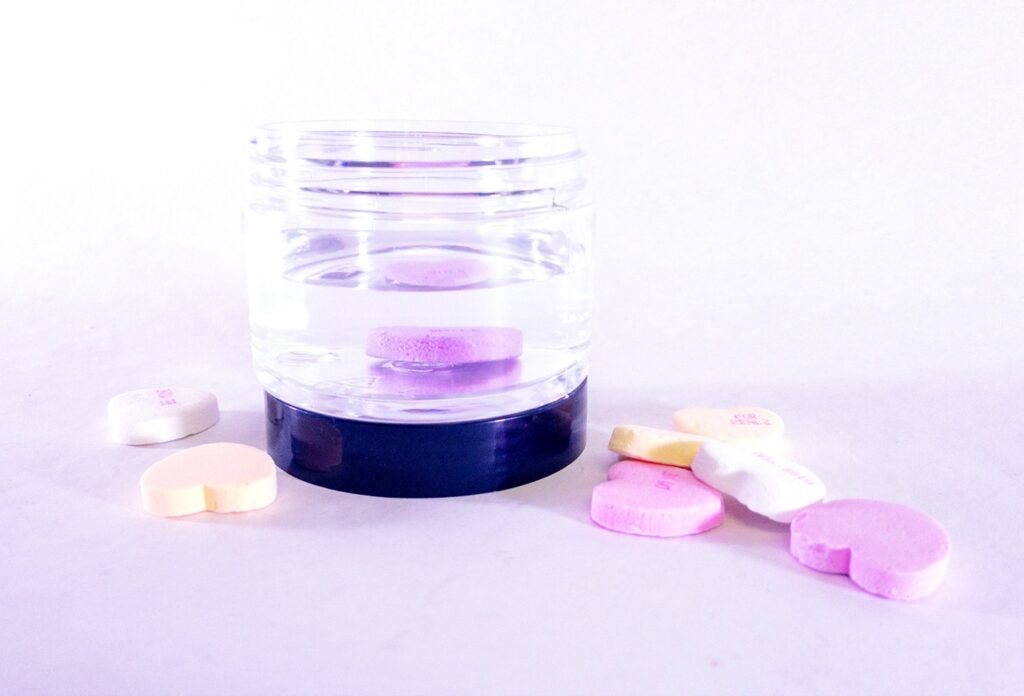
At NIU STEAM, we love to combine holidays with learning! Grab some Valentine candy hearts for a fun and exciting science activity to explore the concept of solubility. This sweet sugary treat is perfect for testing how quickly they are able to dissolve in different types of substances. (Just make sure you save some candy for yourself to snack on!)
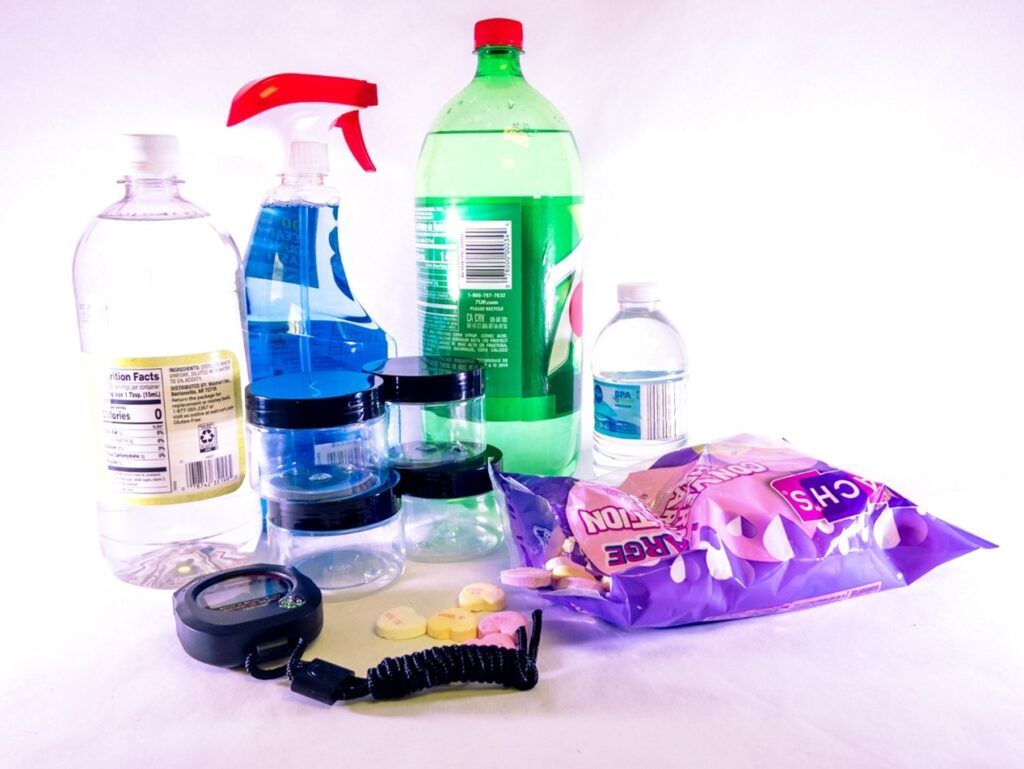
Before you begin, make sure you have an adult to help you gather all of the supplies you’ll need to conduct and carry out this investigation. You’ll want to use a variety of different liquids for this activity. We recommend using water, white vinegar, household cleaner, and clear soda. You could also try other options such as dish soap, oil, juice, hydrogen peroxide, or rubbing alcohol. Whatever liquids you choose, note, it will be easiest to capture the dissolve rate in a clear or a lighter solvent.
In addition to the various liquids, you will also need:
Candy hearts
A stopwatch
4 small jars or bowls, cleaned and dried
Paper
Pencil
Step 1:
Set out your jars/bowls to prepare them for your different solvents. Fill each jar/bowl about halfway with a different solvent. Use paper and tape to label each jar with the solvent inside.
Step 2:
Place your stopwatch nearby and set it to zero.
Step 3:
Drop your candy heart in one of your solvents. Press “start” on the stopwatch as soon as the candy heart hits the liquid.
Step 4:
Observe the candy heart as it dissolves in the liquid. Press stop on the stopwatch as soon as the candy heart has disappeared completely. Note: it can take some time for the candy hearts to dissolve in some liquids, such as water.
Step 5:
Document your data. Use your paper to record the name of each liquid and the total amount of time it took for the candy heart to completely dissolve in the liquid.
Step 6:
Reset your stopwatch to zero and repeat steps 3 – 5 with your other solvents.
Step 7:
Reflect on your data.
Did you press start and stop at the same events for every experiment?
In which solvent did the candy heart disappear the quickest? Why do you think this was the case?
Which solvent took the longest to dissolve the candy? Why do you think this was the case?
Were you surprised by how quickly or slowly the candy dissolved in any of the solvents?
Do you think the candy color or message impacted the data? Why or why not?
Visit our social media channels to let us know if you tried this activity. We’d love to see your pictures and learn about your results!
Happy Valentine’s Day from all of us at NIU STEAM!
It’s the beginning of a new year, which has many of us thinking of something we might want to change, most likely in the food we are eating. Instead of criticizing ourselves for what we are eating, take the opportunity to celebrate the new year with food. This year, try something new! Instead of focusing on breaking a (bad) habit, why not focus on making a positive new tradition? Do you have a neighbor or friend who has a different cultural background than you? Invite them to share a story about a traditional dish they might enjoy, and then get in the kitchen to make the recipe together!
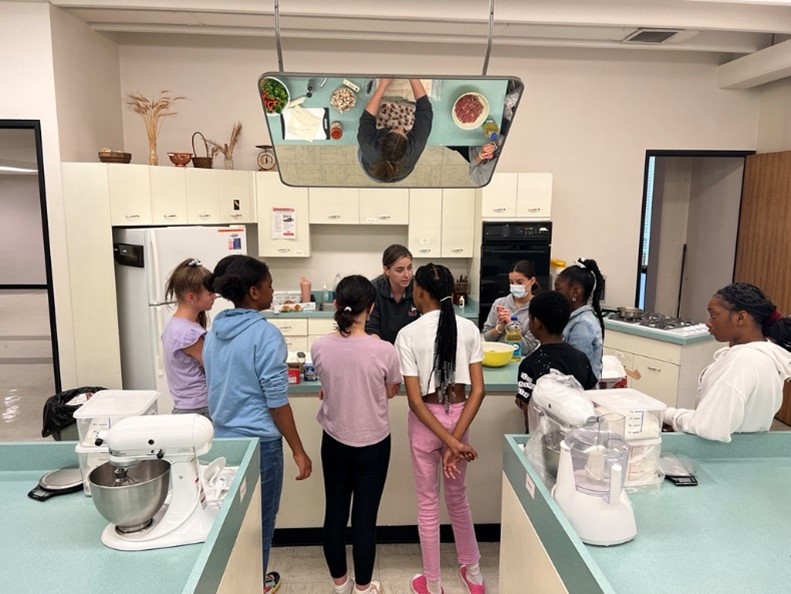
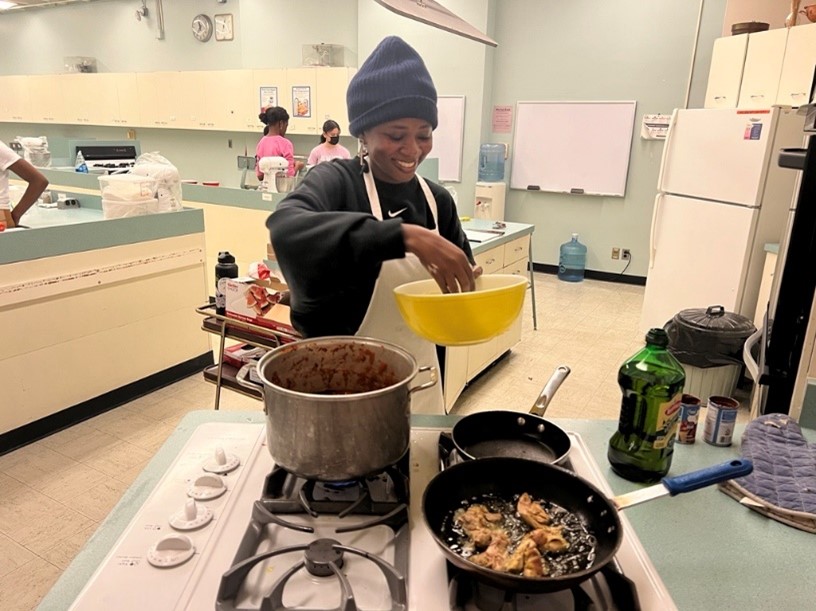
In November, our Barb City STEAM Team celebrated different cultural foods by going on an international taste test. The team learned about various dishes from around the world as the teacher’s passion for food shined bright. We sampled Burek and Sataraš, which are Bosnian dishes we learned from graduate student Jasmina. Jollof rice was another amazing example from Funmi, another graduate student, who had the students frying chicken and making an amazing sauce. One of our own Barb City STEAM Team students, originally from Venezuela, taught the other students how to make Arepas and a delicious egg sandwich. Kerri, one of our NIU STEAM Educators, brought the tradition of Kolaczkis, a Polish cookie, that the students were eager to try. Ana, another graduate student, brought her traditions from Mexico to show students how simple Mexican dishes can be to make. We had fresh-made salsa, cheese enchiladas and tortilla soup!
The Barb City STEAM Team not only learned about different foods – they also tried dishes that were rich in vegetables and ingredients they normally wouldn’t choose. By getting in the kitchen and learning to make their own food, these students are learning invaluable life skills. Small steps in the kitchen help to build confidence right now, and may help the students maintain their health in the long term by introducing them to the building blocks of healthy and delicious food. I love that our students will walk away knowing some basic steps of cooking, how to experiment with ingredients, and why they should always try at least one bite.
If you are going to start the year with a resolution, why not add a new tradition instead of removing a habit you want to change? Take the challenge to try a new food you may not have sampled before, invite a friend or neighbor over and share recipes that are special to your family and culture, or just search for a recipe that you’ve never had before and get into the kitchen! Make your resolution this year to share your story through food with friends and neighbors and start a new tradition of savoring food instead of trying a fad diet that won’t last or work.
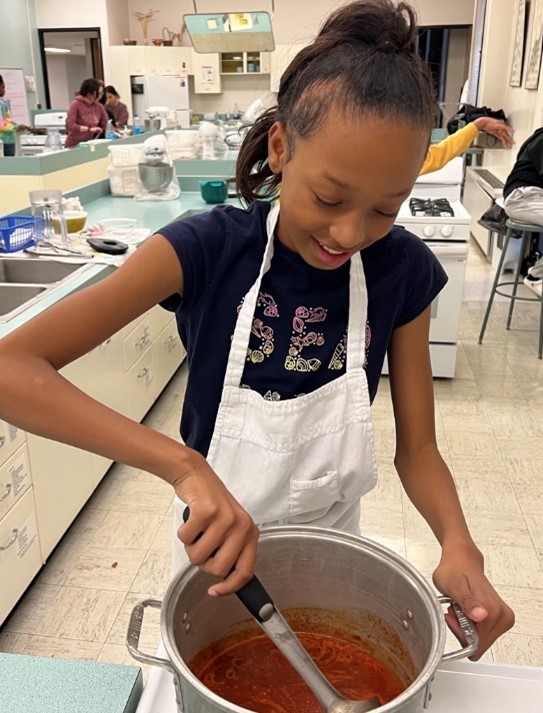
Barb City STEAM Team student Trinity stirs a pot of traditional Mexican Tortilla Soup, taught to the team by Graduate Student Ana.
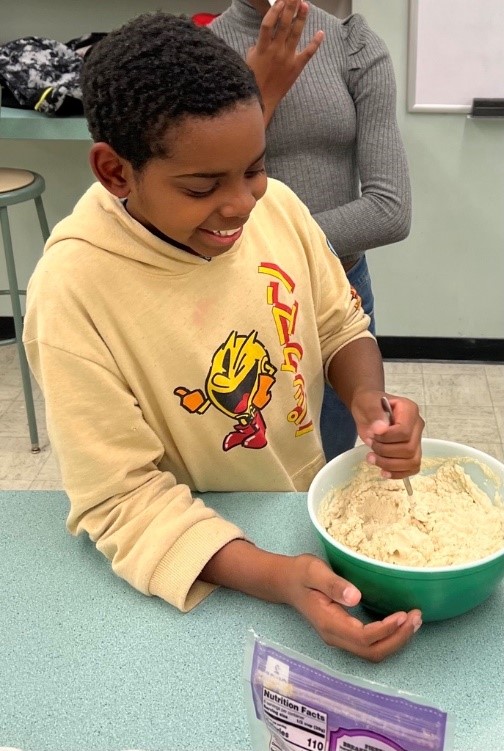
Barb City STEAM Team student Jamon learns from another Barb City STEAM Team student how to make Arepas, a traditional Venezuelan dish.
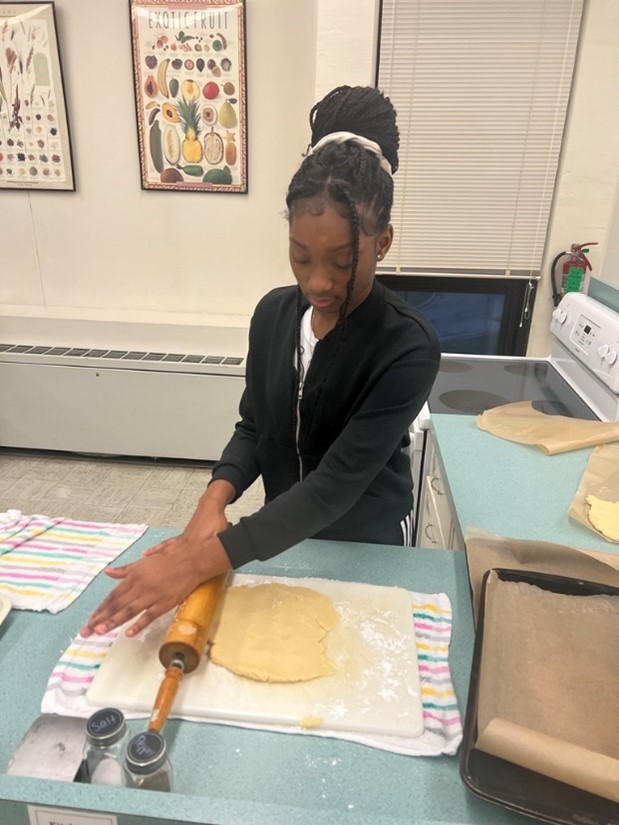
Barb City STEAM Team student Allir rolls out the dough to make Kolaczkis – a traditional Polish cookie they learned about from NIU STEAM Educator Kerri.
Graduate Student Jasmina shows the Barb City STEAM Team the steps to make Burek, a traditional Bosnian dish.
Graduate Student Funmi explains to the Barb City STEAM Team how to make Jollof Rice, a traditional Nigerian Dish.
As we begin the new year and prepare for the deep of winter, many of us may have mixed feelings about that fluffy white stuff that often covers the ground this time of year. Whether you love the clean beauty of a freshly fallen snow or dread the inevitable shoveling and slush, there aren’t many better examples of STEAM in nature than the humble snowflake. From the science of their formation to the symmetry and mathematics that govern their shapes, there is a lot to discover when examining a snowflake. Snowflakes come in a near infinite variety of shapes and sizes, from tiny specks to big fluffy puffs, and everything in between. Let’s take a closer look at how that diversity happens.
Snowflakes form when the air is cold enough for water to freeze. Now that doesn’t mean that snow is just frozen raindrops, that would be sleet. Snow forms when the water vapor in the air freezes directly to form ice crystals in a process called deposition. This is also how ice crystals form on your windshield overnight. A crystal is a solid material that has an organized structure. For example, because of their atomic arrangement, water molecules usually connect at 60-degree angles, resulting in the six-sided hexagonal shapes we associate with snowflakes. When a snowflake, or snow crystal, first forms, water vapor deposits onto a speck of dust floating in the air. This is called nucleation. At the center, or nucleus, of each snowflake is a perfect hexagonal ring of water molecules, frozen around a single tiny speck of dust.
From there, each flake’s story gets more unique. As the newly formed ice crystal is blown through the air, it gathers more water molecules and continues to grow. While the tiny flake is blown about, the entire crystal experiences the same atmospheric conditions, meaning all six faces of the crystal should form symmetrically. A crystal which encounters more humidity will grow faster than one that has less available humidity. Water molecules will also deposit more readily on the corners and edges of the crystal, causing it to expand outward while staying relatively flat.
As the snow crystal continues to travel and grow, the conditions it encounters along the way will determine how the crystal forms. If it encounters fairly constant conditions as it falls, the resulting snowflake will grow evenly, creating facets shaped like hexagonal plates. If the conditions vary as it falls, the result can be a crystal with longer fern-like offshoots, or dendrites.
Because the snow crystal forms from the center out as it falls, we can think of their structures similar to how we study tree rings. Each “ring” of our snowflake tells us something about the conditions it was experiencing while that portion of the crystal formed. Longer, thicker offshoots on the dendrites tell us the environment was more humid, while thinner, shorter dendrites tell us there was less available water at that point in its formation. Because no two snowflakes take exactly the same path to the ground, each snowflake develops a distinctly unique appearance.
While this process describes most of the snowflakes we might observe, there are other possible shapes as well. When the temperature is just below freezing, or there is little available humidity, crystalline shapes such as needles and columns can also form, though these are much less common, and their formation is not as well understood.
Try this at home!
If you’d like to capture and study your own snow crystals, here’s what you’ll need:
A nice snowy day
A piece of black construction paper
A magnifying glass
Patience
Microscope slides (optional)
Toothpick (optional)
Hairspray (optional)
Instructions: Use the black paper to catch falling snowflakes, and then observe them using the magnifying glass. See if you can observe the following:
Are the crystals primarily made of plates or dendrites? Do any show signs of both?
Do all the snow crystals have six sides?
Are they all symmetrical?
What can you tell about the conditions the crystal formed in?
Do you see any needles or columns?
How to preserve your snowflakes:
Spray a glass or plastic microscope slide with hairspray.
Use the sticky side to catch your snow crystal.
Use a toothpick to carefully move the crystal to the center of the slide if needed.
Leave the slide somewhere cold and protected where the hairspray can dry. The water will disappear, leaving an imprint of your crystal in the hairspray.