During this festive time of year, we all see the holiday lights that are hung with the utmost of care, but one light often gets overlooked – the flashlight! Whether it’s guiding our way in the dark, telling spooky stories or helping during emergency situations, these little lights can be useful and fun.
On December 21, it’s time to click on our flashlights and show some appreciation! December 21 is National Flashlight Day, which falls conveniently on the winter solstice, the shortest day of the year here in the northern hemisphere. Some parts of our planet will experience less than 9 hours of daylight, with others, such as the Artic Circle, receiving no sunlight at all. This makes it the best time to light up the night and appreciate the flashlight.
A Little Flashlight History
Using an incandescent bulb and a dry cell battery, David Misell, an American-British inventor, went to work illuminating the world with the very first flashlight in 1899. Today, our flashlights have had quite a few upgrades. From light emitting diodes, or LEDS, to rechargeable batteries, solar powered flashlights and even some specialty flashlights that are flame resistant, David Misell would be proud to see what adaptations have been made to his original design.
And Flashlight Fun
In honor of the flashlight and the winter solstice, let’s take some time to turn out the lights and have some fun! So many games and activities can be done using a single flashlight. Here are a few of our favorites.
Grab a globe and see if you can re-create the position of the sunlight that you will be experiencing on the winter solstice. Take a look at this page from the National Weather Service to get more details about the changing seasons and the exact angle of the earth’s tilt.
Act out a story and make it more luminescent by making shadow puppets on a wall.
Spot your friends in the dark with a game of flashlight tag!
While you’re having fun, take some time out to check your emergency preparedness kit to ensure you have a working flashlight and charged batteries so that you are ready to shed some light during times of emergency.
Have a safe and bright holiday season, from all of us at NIU STEAM.
By Stephanie Dietrich and Newt Likier, NIU STEAM educators
During the time we all spent in quarantine, there was a pretty big focus on hygiene. The CDC recommended humming happy birthday twice while handwashing to make sure twenty seconds transpired, and there were pictures and videos of the correct way to scrub between all your fingers. While we aren’t in quarantine any longer, there’s still a great reason to keep the soap and water flowing. To celebrate National Handwashing week, we wanted to share a lesson on a related topic: how do viruses mutate and why is there a different vaccine every year?
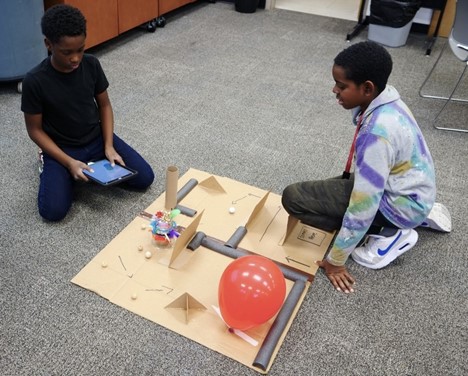
At Barb City STEAM Team, our afterschool program for middle school students in DeKalb, we recently had a focus on biology and viruses. NIU practicum student Abby Singer guided learners through understanding how a virus sneaks into our body and then attempts to infect us. Most of the time, our immune systems kick in fast and hard, dealing with the threat quickly. But as our learners discovered, viruses can change form and disguise themselves in order to work their way through our defenses. To help our students learn about how a virus can mutate and invade a cell, they were challenged to build their own “bug”. They then had to pilot their virus through a maze and try to infect a healthy cell.
For this activity, the students needed: several balloons, a plastic cup, straws, toothpicks, some hot glue and decorations. The goal was to build a virus with the cup as the base, and then navigate that virus into a balloon to pop it. The students also used Sphero robots – mini ball-shaped robots that could sit under the cup and move their “virus” around.
At first, the balloon was unguarded and easy to attack. But, after each attempt, we made the balloon harder to reach or harder to pop. Some things we tried were moving the balloon farther away or giving the balloon some form of armor (like with paper or cotton balls). These modeled the immune system’s protective response.
Our learners used Sphero robots to move their viruses to attack the balloon, but if you’d like to try this at home, you could use any kind of robot or remote-controlled toy. Can you think of anything you could use at home to make your virus mobile? After each attempt, reevaluate your virus and try to make your build more effective or efficient.
This activity may give you a clue as to why the flu vaccine changes every year. There isn’t just one flu virus, but several. Each year, scientists spend a lot of time and effort on trying to figure out which strain (or version) of the flu is going to be the most prevalent that year. Once they have a good guess, the vaccine for that year is specific to their guess. A lot of our vaccinations are effective for a long period of time, like the Tdap vaccine, which you only need to get every ten years. Unlike the flu, there aren’t a ton of different strains of the illnesses that vaccine protects you from.
Other than getting your yearly flu shot, the best protection you can practice is hand washing. We may not be in quarantine anymore, but that’s no reason to stop humming a little song, scrubbing between your fingers, and washing away all the germs we pick up from the world around us every day!
By Stephanie Dietrich, Director, Barb City STEAM Team after school program
During the month of October, the Barb City STEAM Team collaborated with Paul Wright, Professor in NIU’s Department of Kinesiology and Physical Education (KNPE), to connect our students with his pre-service physical education teachers. The plan was for our students to learn team sports while the pre-service teachers gained valuable teaching experience. When we first entered into the partnership, we were excited because we knew that physical activity had positive effects on a student’s overall health and well-being. What we weren’t expecting was how much this programming would impact our students’ daily interaction with each other, their self-esteem and their leadership skills.
Dr. Wright’s students applied a sports education model (SEM), which allows students to take on leadership roles while in the program. Our middle school students engaged in coaching, leading warm-ups and writing articles that document the season. They were allowed to choose their sport and the role in which they participated because it encouraged buy-in. (We were all surprised when they picked handball, but it ended up being a fabulous choice!) From day one, our students were engaged and cared about being there and about being part of a team.
At Barb City STEAM Team, we align much of our programming with the Illinois Essential Employability Skills. Dr. Wright’s work with our students fits nicely within that framework. Our students exhibited cooperative work skills. They also communicated clearly and listened actively. They respected themselves and others. Most importantly, they all showed a positive attitude. Our students learned that there is more to game play than winning and losing. They learned how to work with each other, and they learned how to work with people whom they may not have otherwise chosen to spend time with. All of these employability skills transfer to other areas of life.
One example of this is Dr. Wright placing students in equal teams. This meant that students were not allowed to simply team up with friends. The teams on which they were place consisted of students of different grades, from different schools, and with different interests and backgrounds. Sometimes, removing the student’s choice for grouping themselves can cause students to shut down and lose interest in an activity. Dr. Wright’s pre-service teachers were able to respond very quickly and reengage the Barb City students through team building activities. Before long, students were listening to one another’s ideas, encouraging each other and cooperating towards a common goal.
On the first day of the program, teams were asked to create a poster that incorporated all of their teammates and showcased the team’s name. Throughout the week, students began voicing concerns about teammates who were absent because they wanted to ensure their input was considered in the design and creation of their team’s poster. We were pleasantly surprised to see how quickly they all came together as teams.
Working with the KNPE pre-service teachers allowed our students to become deeply engaged in the athletic process and improved their overall self-esteem. Many of our students have never played an organized sport and did not know what it felt like to be on a sports team. While in gym class they learn about various sports through playing games, their time with any given sport can be limited. The Sports Education Model allowed our students to become skilled handball players and helped build their confidence. Several of our students expressed how much they loved playing handball and how they never knew they were good at sports.
The experience of pairing our Barb City STEAM Team students with the KNPE pre-service teachers went beyond expectations. We continue to see the positive results of the program every day in how students interact with each other and our instructors, and in the way they view themselves. Our Barb City team is very excited to continue to explore partnership opportunities with Dr. Wright and his KNPE students, as well as other pre-service programs at NIU.
To learn more about the Barb City STEAM Team program and ways to get involved, visit the Barb City STEAM Team website.
As the cold winds blow, we’re quickly reminded of the upcoming holiday season and all the shopping that typically comes along with it. Shopping the Black Friday, Small Business Saturday and Cyber Monday discounts has become almost as much of an American tradition as Thanksgiving dinner. Despite rising prices this year, 140 million Americans are expected to spend an average of $362 each, totaling approximately $51 billion dollars between Black Friday and Cyber Monday. Whether we really need all that we’ll buy or not, technology is helping retailers become more and more savvy at finding ways to convince us we do and that we’ll be missing out if we don’t act now to take advantage of the amazing deals and discounts offered.
Not everyone, however, supports the consumerism chaos that begins with Black Friday each year and continues throughout the holiday season. Canadian artist and social activist Ted Dave initiated the first Buy Nothing Day in 1992 to raise awareness about the ethical and environmental consequences of overconsumption and protest consumerism culture. On this day, participants are encouraged to save money instead of spending on useless items that aren’t really needed, simply because they’re being offered at a deeply discounted price.
Buy Nothing Day is a great opportunity to give thought to how our excessive consumption culture is negatively impacting the environment. Every item we purchase requires some level of natural resources to produce. Take the clothing you’re wearing for example. It most likely contains cotton, which requires a significant amount of water to cultivate. In addition, production techniques like textile dying pollute our water system over time by releasing chemicals into our rivers and oceans. The emissions released in the garment transportation process also pollute and dry up our water sources. Buy Nothing Day encourages us to be more mindful about the resources we consume.
This year, Buy Nothing Day will be celebrated internationally on November 25th. Instead of spending, below are some ways you can “Buying Nothing.”
Use this NIU STEAM Lesson to talk about needs and wants with your family.
Encourage friends and family to take part. Spend some time researching talking points about ways they can help the environment and their wallet.
Spend the day making homemade gifts for loved ones.
Clean out closets and donate the things you no longer use or need. Repair items that are damaged to extend their use. Research ways to appropriately recycle worn out clothing that’s no longer needed.
Spend the day doing things that don’t cost money like going on a hike or watching a holiday movie on TV.
We’re sharing some of our favorite recipes so you can try them at home!
By Kelly Furr, NIU STEAM educator
Just over a year ago, the Barb City STEAM Team program began, offering a group of DeKalb middle school students a chance to come to the NIU campus for mentorship, homework help, and – of course – project-based STEAM learning. We knew we wanted the FoodMASTER curriculum – which uses food to teach applied math and science concepts – to be one of the many options students could choose from. And we’re not surprised that it is always one of our most popular classes. There’s nothing more fun than learning with food!
We had just one challenge – we needed a fully equipped food science laboratory for our hands-on scientific inquiry. Thankfully, the NIU College of Health and Human Sciences offered us the use of their food lab in Wirtz Hall. Now, on most Mondays and Wednesdays that space comes to life with the energy that only excited middle schoolers can bring.
In the lab, we discuss various food science topics, then we try out some hands-on learning with experiments and recipes. Recently, we learned all about the science behind microwaves: how do they work, why can they cook food so quickly, and how safe are they to use? (Don’t worry, we debunked some myths and learned to use the microwave safely by avoiding metal.)
Of course, we had to follow up on our discussions with some hands-on microwave recipes. Our only rule is that everyone has to try at least one bite! The students were really surprised that they liked the nutritious “Mugritos” we made.
Keep reading for that recipe and several of our other favorites, including energy bites and chocolate-covered strawberry ghosts!
Crack in the eggs and whisk with a fork, taking care not to tear the tortilla.
Add in your favorite burrito ingredients, like cheese, beans and scallions. Season with salt and pepper and mix.
Microwave 1 minute, 20 seconds. Check and, if the eggs are still liquid cook for 15-20 seconds more. (As Gemma points out, be sure to keep an eye on it so the eggs don’t overheat. You don’t want an egg-splosion in your microwave!)
Let cool for three minutes and serve with sour cream and salsa.
If you don’t have all these ingredients on hand, try experimenting with what you have available! (If you try this, send us a message to let us know what ingredients worked well for you. We’d love to hear about your food adventures.)
Chocolate-Covered Strawberry Ghosts
We tried this for a spooky October treat!
Ingredients:
Strawberries
Vanilla Flavored Candy Coating
Black Decorating Gel
Parchment or Wax paper
Wash and dry strawberries. Melt candy coating in microwave per package directions. Once melted, dip strawberries in the candy coating and place on a parchment paper or wax paper. Allow to cool and harden. Use decorating gel to add ghost face!
Adriana working diligently to decorate her chocolate covered strawberry ghosts!
No-Bake Energy Bites
For a simple recipe that doesn’t even need the microwave, try these no-bake energy bites. They were another Barb City favorite.
Check out this recipe on Get Inspired Everyday. We tried it, and it was a big hit. We made the cake batter and strawberry flavors. Let us know if you try some others!
Eyana is showing off her energy bites we made to learn about measuring in the kitchen!
October is synonymous with changing leaves, pumpkin spice, apple cider, Halloween and – for us – the Haunted Lab!
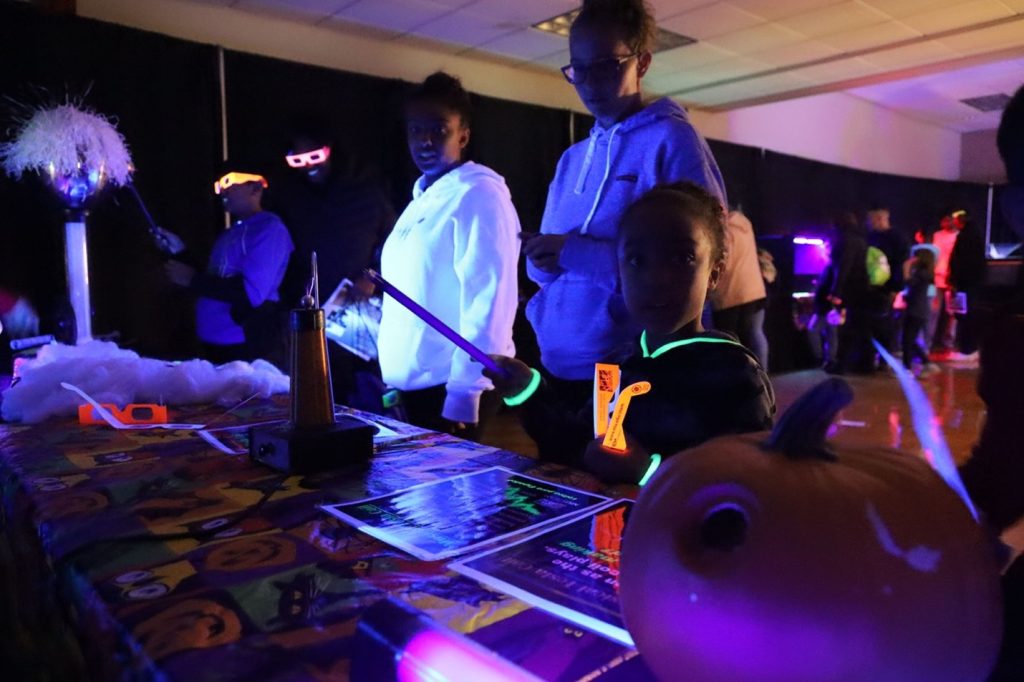
If you’re new to NIU STEAM, you might not know that our Haunted Lab was the original event that eventually grew into our annual STEM Fest celebration. More than a decade ago, our Haunted Physics Lab event became so popular it outgrew its space, and in 2010 STEM Fest was born. Many of our Haunted Lab exhibits have been created and built by our own staff and are designed to demonstrate physics phenomena using “spooky” or mysterious applications.
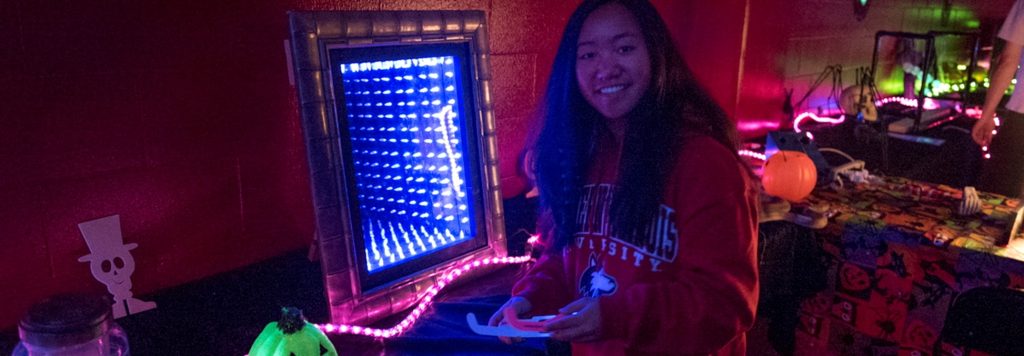
One of the earliest exhibits we created is our own version of an Infinity Mirror. The infinity mirror uses a string of LED lights sandwiched between reflective panes of glass to create the illusion of an infinitely repeating series of lights.
Many of our laser-based displays were constructed as part of the celebration for the 50th anniversary of the laser, which took place in 2010. Our popular laser spirograph is just one example. This exhibit works by aiming a laser at a pair of rotating mirrors. The mirrors spin the laser’s dot into circles and loops reminiscent of old-fashioned spirograph toys. Changing the speed of the two mirrors changes the patterns they create.
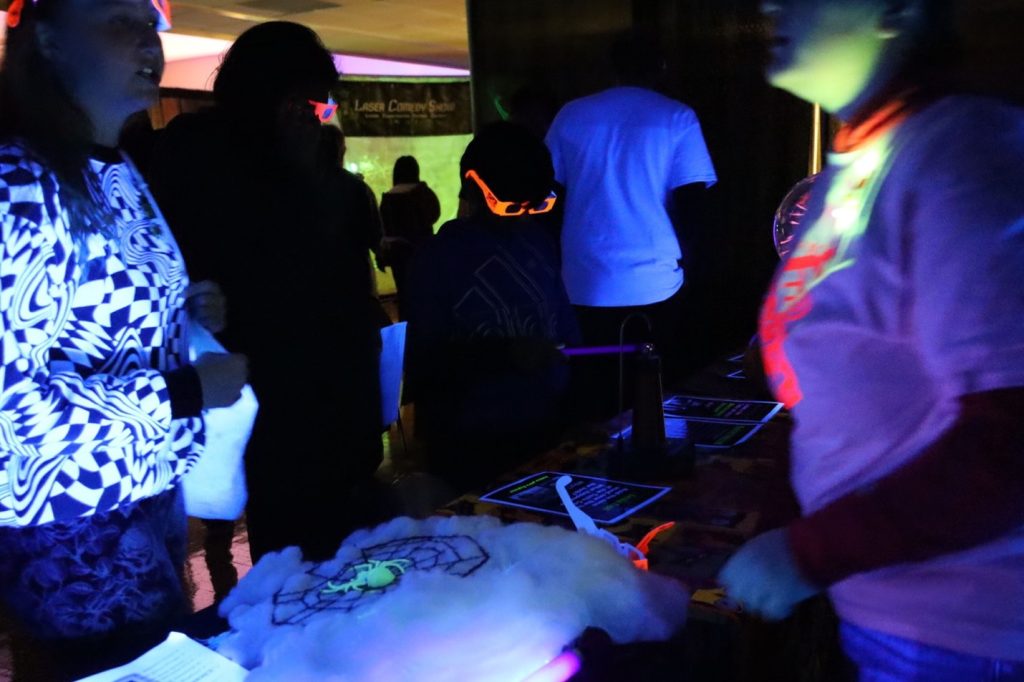
Other displays highlight the science behind common Halloween displays such as high voltage electricity, holograms and black lights with glowing bugs.
Black lights and glowing bugs: DO try this at home!
This is one of our favorite experiments that’s easy to try at home. Glow in the dark items need to be charged using light before they’ll glow. But not all colors of light are as effective. Glow in the dark items react most strongly to violet and ultra-violet light, just like the light given off by a black-light. So if you use a black light to charge your glow-in-the-dark items, they’ll glow longer and brighter than with regular white light.
Here’s how you might experiment with this at home.
Gather glow-in-the dark clothing, toys or other items you have on hand.
Try charging an item with sunlight, an overhead light in your home or a common lamp.
Turn off the lights, watch and record your observations! How long did the item glow? How bright did it seem to you?
Try charging the same item, this time with a black light.
Turn off the lights, watch and record your observations again. Did the item glow more or less brightly, and for how long?
Try this out with various items and types of light. See what patterns you can notice!
Fall is my favorite time of year. It’s not just the cool temperatures or the beautiful colors that make me excited about fall. It’s also all the fun fall traditions. Going apple picking, cheering on my favorite local football teams (and marching bands), enjoying the colorful outdoors with friends and, of course, putting on NIU STEM Fest!
I’ll never forget, thirteen years ago, when Pati Sievert, the now-retired director of NIU STEM Outreach, stopped me in the hall and said, “I have an idea.” She enthusiastically explained her vision for taking the Haunted Physics Lab she had been hosting for years on campus and turning it into something bigger. I listened as she described a large-scale festival to celebrate all things science, technology, engineering and math. She wanted to fill the Convocation Center with hands on exhibits from across campus highlighting how STEM is all around us and impacts everyone every day. Her excitement was contagious and from that moment on, I was on board! A small team of us worked together to make her idea a reality. It was no small feat, but months later STEM Fest came to fruition. It has been so rewarding to be a part of making that idea become an event and help grow that event into a much-anticipated fall tradition. Like a seed from an apple tree, her spark of inspiration has grown into something amazing.
As I think back to that first year of STEM Fest, what really got me excited was Pati’s vision that STEM Fest was an event for all. She wanted to get everyone excited and curious about STEM. Not just the STEM students of a certain age or folks with a specific area of interest, but everyone. I believe that’s why this event continues to be such a fun fall tradition and why so many come back year after year. For me, it has been awesome to see the kiddos who came in the early years come back as young adults. Some even come back as STEAM professionals.
Just like growing the best apple orchard, cultivating a yearly event that meets the need of a wide variety of attendees has taken a team effort and years of thoughtful planning. Each year the STEM Fest team brings in a wide variety of activities to reach different audiences. This year is no exception. We have our crowd favorites such as soldering stations at Build-A Blinkie, our NIU experts showcasing new tech or innovations, and the weather balloon launch. This year we have several new and exciting additions. From the Robotics Expo in Anderson Hall to the Artists’ Playground in the Holmes Student Center (HSC) to Founder’s Memorial Library’s new Science On a Sphere, each space has something new to explore.
There is truly something for everyone. Do you have littles in your group? Be sure to stop by the Tot Spot in HSC, head to Founder’s Memorial Library for STEAM Story Times or check out some of the exhibits in the Innovation Studio. Are you a curious adult? Visit the Curiosity Stage for informative talks or chat with faculty about their latest research in the expo areas.
What about those teens who might be thinking about their future? Encourage them to talk to our NIU students who are representing their clubs or volunteering. They can gain some great insight from a near peer about college life. Or, talk to some of the scientists and experts from Thermo Fisher Scientific, Meta and the two National Laboratories, Argonne and Fermilab. Our exhibitors can tell them about all the possible opportunities in the STEM and STEAM fields. (A fun fact – some of our NIU student exhibitors started coming to STEM Fest when they were young students. Now they are on their way to successful careers. Ask them about their Huskie journey.)
Do you have energetic elementary and middle schoolers? No problem! They can have some hands-on fun in the STEAM Studio in Swen Parson and throughout the exhibit hall. They can even fly a drone! And of course, STEM Fest would not be STEM Fest without the fan favorite, traditional Haunted Lab and the NIU STEAM Roadshow in the Holmes Student Center.
Over the past thirteen years, I cannot tell you how many times I have answered the question, “What is your target audience?” People are surprised when I answer, “Everyone!” It’s not an exaggeration. No matter who you are, you’ll find something at STEM Fest that will help you find your spark! I’ll see you at STEM Fest on October 15 in the heart of NIU’s campus.
Humans have always enjoyed pairing boring tasks with interesting stimulation – telling stories while weaving or singing while laboring. As technology progresses, the way we keep ourselves entertained modernizes. These days, we don’t have to rely on sea shanties or the oral tradition; we have smart phones in our pockets with access to any- and everything imaginable – including podcasts – to keep us focused while we do the boring stuff in life that just has to get done.
In 2021, approximately 87.2 million people in the United States reported listening to podcasts. For those not in the know, a podcast is short- or long-form audio delivered from creator to listener solely through an Internet connection. There are podcasts on true crime, politics, economics, literature – pretty much anything someone wants to hear can be found on one of the many podcatchers out there like Spotify or Apple Podcasts.
For those interested in learning something new, NIU STEAM produces its own set of podcasts to inspire curiosity, generate interested and excitement about STEAM fields and content, share knowledge, and connect with new audiences. On Friday afternoons, you can catch “The Sound of Science on WNIJ” to learn something new about the world around us, or you gain wisdom from someone else’s mistakes with Failure Bites. And if you’re interested in the union of science and fiction, take a listen to The STEM Read Podcast, which connects literature with STEAM experts. All of these podcasts can be found on our podcast website.
The best part of podcasts is that it’s pretty easy for anyone to get started producing their own. If you have a special interest and a heaping helping of dedication, snag a microphone (it doesn’t have to be fancy), record your thoughts (we recommend thinking them first), and start your journey!
Podcasts are great in the classroom too! Here are a few of our favorite no-tech and low-tech podcast lessons for learners of various ages.
Podcast Fun
Idea Sparks
Writing Prompts
What are you really interested in?
What would you most like to research?
Write a script explaining a topic of your choice to an audience that is unfamiliar with your topic.
Discussion Prompts
Have you ever listened to a podcast? If so, which one(s)?
What makes a podcast fun to listen to?
What kinds of jobs are involved in making a podcast?
Mini Lessons
No-Tech Podcast – Young Friends
Materials: Paper, Pencil, A Friend
Procedure:
Talk to learners about how important communication is. It’s really cool to know things, but it’s more important to be able to tell someone else about the things you know.
Ask learners if they’ve heard a podcast before. Explain that a podcast is a story or explanation that’s just heard. It’s like a Youtube video, except you don’t see anything.
Have learners choose something they really like as a topic for their no-tech podcast. Encourage them to choose something special to them, and tell them their topic can be silly or serious.
Once they have a topic, distribute paper and pencils, one per learner.
Guide learners through the basics of a script.
Scripts are a written version of the things we want to say. We write them down so we don’t forget later. Sometimes, it’s hard to remember what we want to say when we’re under more pressure than normal or when people are looking at us, so a script is really helpful.
Scripts can either be exactly what you want to say or an outline of the big ideas.
You can ask learners for the pros and cons of both ways.
Exactly written means you know exactly what to say, but you tend to read and look down the whole time instead of just talking to deliver your message.
The outline gives you a broader idea of what to say, but if you aren’t prepared, you might get nervous and fumble with what to say.
Give learners time to write. Younger writers may need a little more assistance with this process, but let them guide what they want it to say.
Pair learners up and have them deliver their scripts to their partner as practice.
Once both partners have practiced with each other, allow eager learners to present to the group.
At the end, ask learners what they would do differently next time. Give learners plenty of positive feedback for trying something new!
2. Low-Tech Podcast – Young-Mid Friends
Materials: Pencil, Paper, Smart Phone/Tablet
Procedure:
Ask learners if they’ve heard a podcast before. Explain that a podcast is a story or explanation that’s just heard. It’s like a Youtube video, except you don’t see anything. Feel free to use an example of a family-friendly podcast to illustrate.
Tell learners there are many kinds of podcasts. There are podcasts that read stories out loud; there are podcasts that talk about science; there are podcasts that are just a few friends talking to each other; and there are so many more, it would be impossible to cover them all.
Based on this, have learners choose a kind of podcast to try. Once they have a genre, have learners choose something they really like as a topic. Encourage them to choose something special to them, and tell them their topic can be silly or serious.
Once they have a topic, distribute paper and pencils, one per learner.
Guide learners through the basics of a script.
Scripts are a formalized version of what we want to say. Usually, a script is word-for-word what someone intends to say, but some people prefer an outline. In either case, you do not have to say exactly what’s on your sheet of paper.
Have learners begin by making an outline of their main ideas.
Review the outlines and discuss how they could make their ideas stronger or how some reorganization could add clarity.
Using their outlines, have learners write a fuller script.
Pair learners up and have them deliver their scripts to their partner as practice.
Once both partners have practiced with each other, send learners in small groups or pairs to a quiet corner to use their phone or tablet to record.
Most phones and tablets should have an app for voice recording already installed. If not, they usually have a free app to download/install.
Ask learners to share their podcasts after the recordings are finished.
At the end, ask learners what they would do differently next time. Give learners plenty of positive feedback for trying something new!
Happy International Dot Day! Every year on September 15, millions of people across the globe participate in activities based on The Dot by Peter H. Reynolds. This delightful picture book written in 2003 illustrates the journey of Vashti, a student who believes she cannot draw. Her art teacher encourages her to “make a mark and see where it takes you.” Vashti responds with frustration, simply marking her paper with a dot. Her teacher silently encourages Vashti by displaying her anger induced dot for all to see.
Seeing her dot on display inspires Vashti to make a better dot and sets her on a mission to improve her drawing. In the process, she creates an entire art exposition comprised of dots which impresses a little boy who’s also convinced himself that he cannot draw. Vashti shares the encouragement she received from her teacher with the little boy.
The Dot is not only a story of perseverance and gaining confidence, but also the power of encouragement and patience. Her teacher, through patience and understanding, helps Vashti to see herself differently, which inspires a love of art and creating artwork. Vashti learns that what she initially saw as failure could be used as a steppingstone for improvement and mastery. This is one of the foundations of STEAM learning.
At NIU STEAM, we celebrate failure as a part of the iterative process of development that leads to innovation and discovery. Perseverance through failure is necessary, not only for STEAM education, but for all learning. How many times do we see students so afraid to fail that they do not even want to try? Stories such as The Dot help students see how persisting through their own discouragement and lack of confidence can lead to success, if they can muster up the courage to take that first step.
Celebrate International Dot Day with your own students or children. Check out our own lesson based on The Dot.