By Lindsay Van Geem and Chrissy Swartz, NIU STEAM Educators
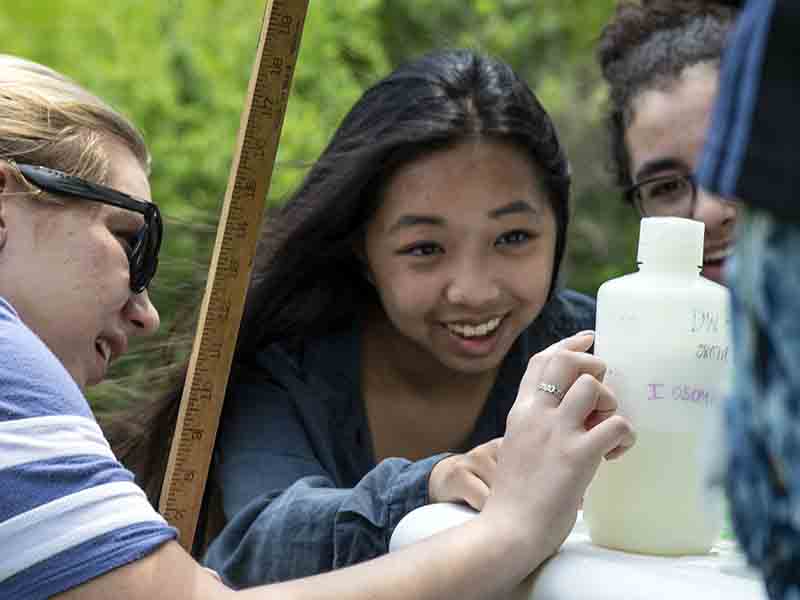
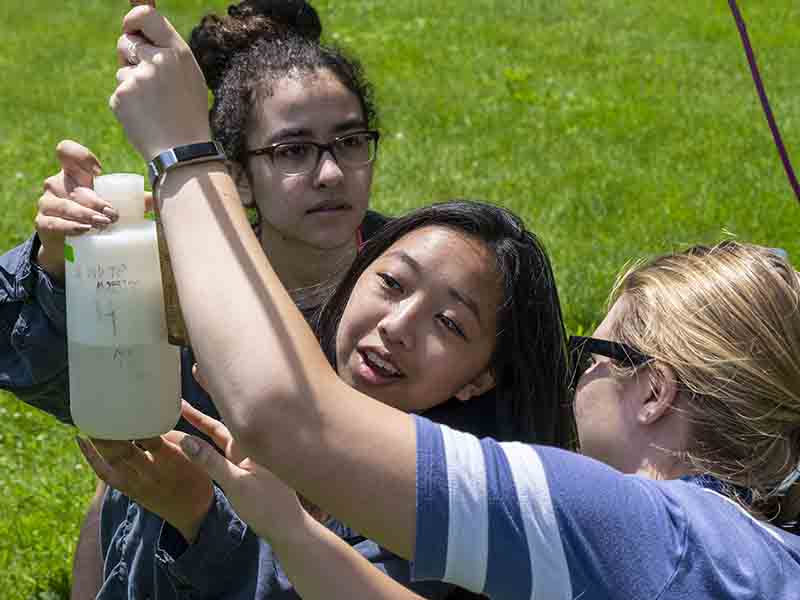
This summer, NIU STEAM is excited to offer a brand-new camp experience for students entering grades 9-12 who are interested in exploring the impactful world of sustainability related careers. In a world where environmental changes are continually happening, understanding sustainability isn’t just an option – it’s a necessity. In this Sustainability Career Exploration Camp, campers will work and learn alongside professionals and current students within the field to gain invaluable insights into various career paths, from environmental science to sustainable engineering and beyond.
With NIU STEAM, our camps are all about hands-on learning. Campers learn about the latest research supporting natural resources, eco-systems, renewable energy and addressing climate change by rolling up their sleeves and immersing themselves in exciting projects and activities. We’ll spend time exploring prairie plant species growing in NIU’s scientific prairie restoration area, learning ways we can reduce pollution and protect human health through green engineering, and even taking a bite from some fresh veggies grown in the gardens on NIU’s campus. Throughout the week, campers will design their own sustainability project. They’ll take what they learn and bring it back to make a difference in their local community.
A week at NIU STEAM camp isn’t just about learning – it’s also about fostering lifelong friendships and connections. Campers collaborate on projects, exchange ideas, and build a network that will support and inspire long after the camp ends. Don’t miss out on an unforgettable summer experience that will give you the tools to help create a more sustainable future!
In this episode of Winning Ideas, let’s give the planet a hug this Earth Day!
Imagine this – it’s the break of dawn, the sun is just peeking over the horizon, the sky is clear with just a few clouds that turn orange-y pink at the first rays of light, everything is still and quiet. Then, from the trees and fields comes a cacophony of songs and noises – birds, bugs and even the occasional fish jumping out of the Rock River. Everything is coming alive and welcoming you to a new day.
You head to breakfast, sitting in a terrace on a cliff, overlooking the river, turkey vultures floating low, right at eye level, the trees bright and green, and the smell of fresh cinnamon rolls wafting through the cool, clean morning air. You are waking up on your first morning at summer camp! This is no ordinary summer camp, though – this is an NIU STEAM summer camp. You are at Lorado Taft, NIU’s outreach field campus nestled in the woods and sitting atop imposing cliffs overlooking the Rock River.
Once an artists’ retreat during the late 1800s, this peaceful respite from city life has been under the care and maintenance of NIU for nearly 75 years. As the art scene was growing in Chicago, a group of artists sought creative isolation from the hustle and bustle of city life. They escaped and created the Eagle’s Nest Colony on the estate of wealthy lawyer, Wallace Heckman. For decades, artists came and went, creating beautiful art and setting the scene for preservation of wilderness spaces in Illinois. In 1951, then NIU President Leslie Holmes sought to purchase the land and build it into the teaching campus it is today. A sanctuary for birds and wildlife, Lorado Taft is also an opportunity for people to learn how to coexist with nature peacefully. Today, the campus hosts groups, researchers, and students all seeking the peaceful environment, rich in learning and art.
One of the biggest tasks of honoring the land and ensuring its care for future generations has been keeping the land, plants, and wildlife healthy. The work is never ending! The staff at Lorado spend time curating healthy trails, clearing dead brushes, and removing invasive species from the land. But everything looks like it belongs, you may say. What are invasive species? According to the USDA, invasive species are “non-native plants and animals living in areas where they do not naturally exist.” Their presence or introduction will “likely cause economic or environmental harm or harm to human health.” For Taft, that typically means invasive plants that grow really well in the area, but their growth and spread chokes out the native species causing them to die off and change the dynamic of the environment.
While some changes have happened naturally as the landscape has evolved, some come in quickly and take over rapidly. Let me share an example from Alaska, where I lived before moving to Illinois. Students studying at the University of Alaska, Fairbanks, accidentally released bird vetch, a beautiful purple flower that grows like a vine. The bird vetch spread like wildfire – choking out many native species, including fireweed, by climbing the plants and monopolizing the sunshine. Fireweed, an important pollinator and a plant honored by the first people of Alaska as a way to evaluate snow fall, know the changing of seasons, and an important part of the diet, can’t compete with the bird vetch, with its voracious growth and appetite for sunshine. Volunteers and state and federal workers are currently seeking to eradicate the species from as many places as possible, but it’s hard. Once an invasive species takes hold, its removal becomes almost a full-time operation.
At the Taft Lorado Field Campus, garlic mustard and honeysuckle have begun trying to take over the hardwood and pine forests we are working to preserve and protect. To remove garlic mustard, workers are pulling it up, ensuring they have the roots so it doesn’t regrow. That means bending and pulling each plant by hand and with tools. For honeysuckle, campus employees are cutting back branches and trying to remove their roots, or if they can’t get the roots, applying an herbicide (plant killer) to the cut areas to prevent future growth. These are labor intensive jobs – but they are carefully done to protect the native plant species as well as the bugs, birds and other creatures that depend on our forests for a safe space.
The job of nature preservation is incredibly tough! So you may now be asking: how can you help, especially since it’s almost Earth Day? There are a lot of ways people can help! Especially in their own gardens, yards, windowsills, etc. It all starts with knowing what’s local. In the Chicago region alone, nearly 45% of trees that are planted in yards and outdoor areas are considered invasive. Here are some tips to help you avoid those.
Don’t just select plants that you saw in that one movie from a faraway land – those likely aren’t suited for your environment!
When you go to the store to purchase a plant for your yard or garden – ask the employees if the plant you want is a native or invasive species. If you shop with local growers, they often can tell you all about the plants you are selecting.
Before going to the store, do some research on invasive plants in your area. Keep this in mind: most vegetables are considered “non-native,” but because they don’t spread and take over and they are easy to contain, they are not considered invasive.
If you’re feeling truly inspired to protect our native land, consider volunteering with your local forest or park district.
You can also look for information on the Chicago Region Trees Initiative, which will help you find volunteer opportunities, removal options, and safe species to plant in your yard.
If you’re looking for an easy lift – visit your forest preserve website to see what fun events they have planned for Earth Day. Maybe you’re planting a native species tree or out cleaning up the parks. Who knows – you might inspire the next generation of conservationists to help take care of our home – good old planet earth.
Hey friends! NIU STEAM Summer Camps are coming up soon! Take a moment to register your kiddos for camp. We offer day camps for students in grades 2 through 5 and middle school, overnight STEAM camp for middle school at Lorado Taft Field Campus, and college/career focused hands-on resident camps for high school students. Act quickly – early bird pricing ends April 30!
Don’t forget to share your projects with us! Tag #NIUSTEAM and @NIUSTEAM for a chance to be featured in our weekly newsletter.And as always, do good things, be good people, and make yourself better than the day before.
Coming up on June 7, 2024, NIU STEAM and the Illinois MTSS Network are co-sponsoring the STEAMing It Up Conference: Using MTSS to Support Students in Literacy and STEAM.
To find out more about what makes this conference special, we spoke with Dr. Kristin Brynteson, director of NIU STEAM.
Why don’t you start by telling us a little bit about what STEAM is?
At NIU STEAM, we think about STEAM as more than just science, technology, engineering, art and math. It’s really about creating a learning environment that’s hands on, experiential, that connects to the content areas through driving questions, inquiry and exploration.
To do this, we apply sound instructional strategies that create engaged learning environments – learning environments where the teachers and students are working together, where the students are taking more of the cognitive load and the lead in learning, and where they’re learning through productive struggle, community connections and authentic problem solving.
How can STEAM learning help educators reach their school improvement goals?
The STEAM learning lens is all about, how do you create personalized learning experiences that meet the students where they are? How can you design learning experiences that provide a low floor of entry so all students can access the content, but also a high ceiling where they can go in the direction that meets their needs and interests? So a STEAM approach can be an additional tool to design a classroom that is truly engaging for students.
Can you say more about how STEAM hands-on lessons work?
Hands on lessons involve students building, creating, experimenting and exploring. The students are doing science or creating prototypes of their own designs. Many times, we start with a challenge or problem and allow students the time to brainstorm ideas, collaborate to build and create. We design hands-on STEAM learning experiences that are centered on driving questions – so we always begin with the question and get students motivated to find the answers or solutions to problems.
Many times, students work in groups so each one can take on a different role and work to their strengths – and the students help and teach one another. Another way to implement hands-on learning is with STEAM stations that students can rotate through with different types of challenges. The students can select a challenge from several choices. It’s about giving a lot of voice and choice to students.
It can sometimes seem overwhelming to teachers to introduce hands-on or project-based learning. Do you have recommendations for manageable ways to bring STEAM learning into the classroom?
STEAM is not about starting from scratch. It’s really about looking at what you’re already doing and finding those areas where small modifications or small ways to reframe things can change the learning environment to be more student driven, less teacher driven. How could it be more hands on or connected to an authentic problem? What are ways you could connect the learning to future careers or maybe connect to other content areas? At the conference, educators will learn about some more specific ways to do this at different grade levels!
Why are you excited that this conference is bringing STEAM and MTSS together?
We’re all focused on the shared goal of student success – and we have different strategies that we bring to the table. Anything we can do to expand our toolkit of strategies is good for students!
I’m excited because we’re learning from each other, looking for those connections between STEAM and MTSS and looking for how they support each other. We’ve not really explored that thoroughly yet, so this is giving us an opportunity to come together and have those “aha” moments along with our attendees. Hopefully, no matter which topic attendees are most interested in – literacy, STEAM or MTSS – they’ll sit in on some of the sessions on other topics and will start seeing connections they might have never thought of.
I’ve heard you talk about “productive struggle” in STEAM education. Can you share more about that?
In hands-on STEAM learning, it’s great to start by letting students explore their strengths and see how far they can go. But then there’s always going to be that moment of struggle – what we call productive struggle. We want students to be curious enough and motivated enough to not give up when they struggle, but to be resilient and use internal and external tools to deal with challenges.
Hands-on STEAM projects can also be a great way to introduce new math or science skills that are just a little beyond what the student has already mastered. Because when students are trying to solve a problem or answer a question they’ve chosen, that math skill has a larger purpose. It offers motivation and takes care of the “why are we even learning this?” question.
What are some of the conference sessions that you’re most looking forward to?
I’m really excited to learn more about the literacy plan from ISBE. I’m looking forward to understanding more about the literacy plan and what that means for our teachers and students.
I’m always excited when Argonne National Laboratory representatives comes, so I’m really looking forward to the Argonne session about Artificial Intelligence. I’m excited about their perspective of breaking open that black box of AI so we can find out, how does it actually work?
I’m also going to attend a lot of the MTSS sessions because that’s new content I’m excited to explore. I’m particularly looking forward to Kari Harris’s session on Building Vocabulary: Strategies for Contextualizing, Rather Than Memorizing. Vocabulary is a huge part of STEAM learning, so I know I’ll learn some strategies we can use in our NIU STEAM camps and after school education programs.
Of course, I’m also always excited to hear from our NIU STEAM educators – especially Jasmine Carey’s discussion of how to create your own classroom maker space.
What unites all these sessions for me is that we’ll be learning how to help our students become innovative, creative thinkers and problem solvers. It’s about moving the learning up Bloom’s Taxonomy so it’s not just about recall or memorizing – but how can students take this knowledge, make it their own and apply it to something new and creative?
Can you say more about student motivation and why engaging hands-on lessons are important?
Right now, attendance gaps are a big challenge for schools – so engaging students, getting them intrinsically motivated is one important way to make sure students are showing up, paying attention and ready to learn. When students discuss and address actual problems they’re seeing in their community, that answers the “why are we learning this?” question. It empowers students to be more active in their own learning and their own community.
Is there anything else that you want people to know?
At every conference one of the best things that happens is all those hallway conversations – and with this partnership between IL MTSS-N and NIU STEAM, we’re going to have some really unique hallway conversations! We’re bringing together different groups who might not normally be at conferences together, and we can’t wait to see the connections that they make.
To find out more about what makes this conference special, we spoke with Lori Hensold, director of the Illinois MTSS Network.
How did the idea for this conference come about?
This started from a conversation between Kristin Brynteson, director of NIU STEAM, and me. We saw that we each serve educators from different areas within schools, but they all work together to teach students. Why not show them how to collaborate better and more smoothly? Why not try to get them together and show them how things connect?
Because so often in education you go to a workshop and get a little slice of learning, and then you go back and try to use it – but it’s not connected to anything else, and that can make for a very chaotic and confusing approach.
There’s a phrase you hear sometimes – random acts of school improvement. Instead, we want school improvement to be more coordinated, connected and systematic. Discovering and creating connections among different educators and different fields is an important way to do this.
Can you share a little bit about what MTSS is and what approach you take to it at the Illinois MTSS Network?
The biggest strength of MTSS is that we focus on evidence-based practices and strategies to support students. Whatever subject or grade level you teach, those evidence-based practices can be useful tools.
MTSS stands for multi-tiered system of supports. We think of it as a framework to continuously improve the way you serve students. The bottom line is giving students what they need, when they need it and how they need it.
Some students need very little. You could practically hand them a book and walk away, then come back, and they’ve learned something. Other students need a lot more support. What we want is for everybody to graduate with the skills that they need to be healthy, happy, contributing members of society. As educators, we all share that goal! But often I hear schools saying that they don’t do MTSS because they don’t understand what it means.
What we do in MTSS is use different types of data to identify students who need something more to be successful. That “data” could be as simple as a formative assessment or maybe an observation – just walking my classroom and noticing who gets it, who doesn’t get it and who needs more support. It can be more formal assessment or even diagnostic assessment to uncover student strengths and needs.
The “something more” can be as simple as maybe I pair them up with someone who knows the skills and content really well. Or maybe I assign the rest of the class a small-group project to work on while I work one-on-one with a few kids who seem to need extra practice or feedback. Maybe I pre-teach, meeting with those students for 15 minutes in advance of class. I’m always looking for what the evidence say works best for students.
There are a lot of different ways to provide the “something more.” MTSS helps us build a continuum of supports so we can meet each student where they are.
What are some of the conference topics and sessions you’re most excited about?
The AI session from an Argonne National Lab scientist is really intriguing to me because I have no idea about that, so that will be totally new and interesting to me! I’m curious to see how it dovetails some of the other things that we do.
I’m also fascinated by the STEAM stories session from NIU STEAM – the idea of using stories that focus on science, technology, engineering, arts or math is a very interesting crossover between literacy and STEAM education.
The Illinois reading Council is also doing a session about incorporating STEAM learning into the Illinois Reads books – they’re making some connections that I think we can benefit from.
I’m also looking forward to some basic sessions our MTSS coaches are doing on, what does it look like when MTSS is successful in a school? What are some of the barriers? What are some of the ways you can leverage what you already have to make MTSS work well?
I’m also very excited for the keynote featuring three representatives from ISBE. They chose to provide a joint presentation with a literacy expert, a math expert and a science expert – so that’s going to be a wonderful kickoff for the day and start making those interdisciplinary connections right away.
We have a nice variety of sessions, and I can’t wait to talk to attendees afterwards to find out what they learned and what connections have turned up because of the conference.
Why is it exciting to have literacy, math and science together in the keynote talk and the conference as a whole?
Everything is together in a classroom, even when we try to keep the disciplines separate! If you’re teaching science, for example, the students are still reading a textbook. They’re reading background information and directions. If they do an experiment, they’re writing out their results. So that literacy component is always there, and it influences how successful students can be in other subjects.
What it comes down to is – especially with schools consolidating and having fewer staff – our approach has to be all hands on deck. Even though we each have our own area of specialization, we can better serve students when we share a common understanding and a common language about those core skills, such as literacy and math. To some extent, every teacher becomes a literacy teacher. It really does take a village!
What else do you want people to know about the conference or about MTSS?
Part of the focus of the conference is on Illinois’ new literacy plan that is mandated to be implemented across the state. Students in Illinois were struggling to learn to read, and it became clear that the state needed evidence-based teaching practices to improve literacy. That fits really well with what we do at MTSS. We are always asking, what is the evidence base? Why are we teaching this way? What teaching methods do we need to reach every student? We really want to see the literacy plan succeed and to see every student thrive. For this to succeed, we all need to pull together.
An interview with Amy Jo Clemens, Ed.D., NIU Assistant Vice President of Outreach, Engagement and Regional Development and Director of the Center for P-20 Engagement
In the fall of 2022, the Illinois MTSS Network (IL MTSS-N) moved to NIU. In fact, it’s housed right here with us in the P-20 Center in the NIU Division of Outreach, Engagement and Regional Development.
To find out more about how MTSS can help all of us be more effective educators, we returned to this interview with Amy Jo Clemens, NIU assistant vice president for Outreach, Engagement and Regional Development and director of the NIU Center for P-20 Engagement. As a former high school science teacher, principal and superintendent, Amy Jo has seen MTSS in action and is a passionate advocate for using MTSS to improve learning outcomes and equity.
We sat down with Amy Jo to ask her a little bit about why she’s excited about using MTSS in schools.
Why do you love MTSS? It’s the most powerful way for schools to take all their resources and align them to support students equitably, efficiently and effectively. It’s proactive and preventative, so we aren’t waiting until students fall way behind – we’re looking at data to anticipate students’ needs and support them to success. MTSS helps schools work smarter, not harder, by building systems that monitor and intervene early with interventions tailored to the student’s particular problem.
How does MTSS use a systems approach to equitably address the needs of every student? With MTSS, you create a system that monitors the performance of individual students and then intervenes early. System-level strategies ensure that all students are monitored and all students have access to interventions that they need. In MTSS we identify a student falling behind and go through a problem-solving process to address the issue. Is it poor attendance, missing instruction due to frequent moves, additional time needed to master new skills, or that they haven’t mastered foundational skills they need to move forward? MTSS helps schools build a system that finds students just starting to fall behind so staff can intervene early with supports tailored to the students’ needs. This is key in an equity-based system.
Can you give an example of how that works in practice?
I can give you an example from my own life! When I was in first grade, I was in speech classes “down the hall” and ended up missing the class time when my teacher taught subtraction. I was very confused and ashamed that I couldn’t subtract when the rest of my class seemed to act like it was easy! My dad realized I hadn’t learned it, and over Thanksgiving break – I remember this vividly – he sat me down, laid out table knives on the dining room table at my grandmother’s house, and taught me subtraction. That was the little bit of support I needed to get back on track. Without that “intervention” (i.e. increased time and smaller group instruction) I might have gone on to greater math deficiencies! MTSS helps schools build systems that do this for all students.
MTSS is a three-tiered system. Can you say more about how the three tiers work?
The goal is that schools create a system where 80 percent of the students should be getting all they need from their classroom (tier one). In tier one, you have social emotional learning, trauma informed classrooms, as well as academic content and interventions provided to students by their general education teacher in their classroom. The school goal is to then have about 15-17 percent of the students on tier two, where they get a little extra help, maybe an hour a day, in an area where they’re struggling. Only about 3-5 percent of the students can be on tier three, getting regular individualized interventions tailored for their needs. In a well-designed system of supports, every student gets what they need, which is what makes it equitable for all.
MTSS Evidence-Based Practices
MTSS is evidence-based. Proven interventions work to provide real solutions that you can implement at a system level. We encourage you to explore the IL MTSS-N website to learn more about many different evidence-based practices!
At the core of MTSS is data-based decision making.
We use multiple measures of data to:
Maximize student academic, behavioral and social emotional outcomes.
Identify gaps between expected outcomes and current student performance.
Anticipate patterns of student performance across diverse groups.
Make informed decisions that support continuous improvement.
Here are a few of our favorite data-based decision making resources available on the Illinois MTSS website.
Problem-Solving Using the ICEL/RIOT Matrix One tool that can assist schools in their quest to sample information from a broad range of sources and to investigate all likely explanations for academic or behavioral problems is the ICEL/RIOT matrix. This matrix helps schools to work efficiently to decide what relevant information to collect on academic performance and behavior—and how to best organize that information. Check out this resource to learn more about the ICEL/RIOT Matrix.
This is an exciting year for solar activity as we prepare for the world’s longest land-based total solar eclipse in over a decade! The path of the eclipse in North America will cross parts of Mexico, 15 U.S. States, and five provinces in Canada, creating a beautiful spectacle that will dazzle everyone who takes time to, safely, look up to the sky!
A solar eclipse is a rare, celestial event that occurs when the moon passes between the earth and the sun. This causes the moon to create a huge shadow that blankets part of Earth because the sun’s light is either partially or completely blocked from view. If you are in the regions where the moon will completely block the face of the sun, you are in the area known as, the path of totality. The sky will darken giving the appearance of dusk, or if conditions and your location are perfect, the appearance of night!
If you live in the United States and miss out on this year’s eclipse, you will have to wait until the next total solar eclipse to be visible in the lower 48 states, which won’t be happening until August 23rd, 2044. To ensure you don’t miss out this year, you can make your own solar eclipse viewer out of materials you can find around your home!
DIY Eclipse Pinhole Projector
How it Works!
For viewing the eclipse, a pinhole projector is a device that creates a light projection of the sun and the moon’s shadow onto the inside of the box through a focused beam of light. The tiny hole that the light will shine through acts as a small camera lens. The light enters through the small hole, it gets focused and projected to the other side of the box so that you can see the image!
Materials
Thin cardboard box (like a cereal box)
Masking or clear tape
Scissors
Permanent marker
Foil
Toothpick
Construction paper, stickers, markers (Optional)
Steps
Using a permanent marker, draw 2 small squares, about 1-2 inches in size, on one end of the box. One square should be on the top left-side of the box, the other square should be on the right-side of the box top.
Cut out both marked squares on your box top.
Next, cut a piece of foil that will be large enough to cover one of the square holes that you previously cut out and tape the foil over the top.
After you secure the foil over one of your squares, use the toothpick to poke one small hole for the sun to shine through.
Decorate the outside of your box to help celebrate the eclipse!
How to use your viewer:
To use your pinhole viewer to observe the eclipse, stand with your back to the sun and hold up your pinhole viewer so that it catches the sun’s light. During the partial phases of the solar eclipse, you should see a projected image of a crescent sun inside your box. During the height of the eclipse you might be lucky enough to see the annularity, or the maximum phase of the eclipse when the moon’s entire disk is silhouetted!
SAFETY NOTE
It is not safe to look directly at the sun without proper protection. Viewing the sun through a camera lens, binoculars, or telescopes without the proper filters and eye protection will cause severe eye injury.
There’s an age-old saying, “March comes in like a lion and out like a lamb.” Storms in the spring are intense! In this episode of Winning Ideas, let’s better understand where tornados come from, how they are classified and what to do when you hear the siren sound.
Are you the standard Midwesterner – the tornado siren sounds, and you RUN, not to your basement as they recommend, but to your garage to get a better look at the storm? You might be saying to your family something to the tone of, “Whoa – look at those dark clouds!” or “Did you see that lightning strike? That was a good one!” Or you’ve got your phone out recording the storm as it traipses by your house. Well, not me! I am not originally from the Midwest so when the sky threatens to eat you – I take cover!
Here in the Midwest, we are fortunate that tornado sirens are tested regularly, and we learn what that sound means. But sometimes tornados can strike before a warning can go out. If you are at home or on vacation where sirens might not be around, it’s important to be aware of the weather, especially in months when tornados are common, like spring. When it comes to the signs mother nature gives, there are four clear warnings on when to seek shelter. First, look at the clouds during a thunderstorm. Tornado clouds will often be very dark or appear purple or green in the sky before a strike. Second, clouds may feel like they are sitting lower than normal, or they appear very close. Third, hail is a common side effect of tornados as the weather is mixing warm and cold causing a difference in temperatures from ground to sky. Finally, you may hear a very loud sound, like a freight train barreling towards you at a rapid rate. If any of these things are happening – seek shelter, you are likely in the path of an oncoming tornado.
Some of you may be asking, why are tornados so much more common in the spring than in any other season? Also, how are they classified? According to the National Oceanic and Atmospheric Administration (NOAA), tornados form when temperatures on land and in the sky are drastically different. For a tornado to form there needs to be warm, wet air closer to the ground and drier, colder air in the sky. Those two things alone don’t start the tornado, but they are the key ingredients to create an unstable atmosphere. When you add in the wind, the weather is primed for a tornado. The warm air tries to rise while the cool air tries to settle, when you add in wind as a factor, you can start to see rotations of the drafts (the warm air going up and the cold air coming down), potentially forming a tornado funnel. NOAA states that tornados are, “violently rotating columns of air, extending from a thunderstorm, which are in contact with the ground.”
When it comes to classifications of tornadoes, the United States uses the Fujita Scale. The Fujita Scale (EF Scale) is a way for scientists to measure severe storms and how much damage we predict they will cause. Tornados are ranked from EF 0 to EF 10. Most tornados we see are considered weak tornadoes (EF 0 – EF 3). They have wind speeds up to 100 mph and last only a few seconds. There are occasionally strong tornadoes (EF 4 – EF 7), which have wind speeds up to 200 mph and can last a few seconds to a minute. Finally, there are super rare tornadoes that are classified as violent tornadoes (EF 8 – EF 10). These happen very infrequently but cause the most amount of damage. They can have wind speeds up to 300 mph and last anywhere from a few seconds to minutes on end. Fortunately, violent, and even strong, tornadoes are not common. But, even if the tornado is considered a weak one, it’s still important to seek shelter. Basements are frequently suggested shelters because they are enclosed and typically have few windows. When a tornado becomes more violent, the shaking and blowing can cause windows to shatter and flying glass is always a problem. The goal is to find a safe place as close to the Earth as possible. Have water, snacks and batteries/external chargers ready to go in case an emergency strikes your home or school.
While we are imparting the importance of staying safe, it’s also really fun to learn about tornadoes with your class! Here are some weather-related activities across the grade bands:
Kindergarten – 3rd grade: mimic a tornado with your students with a “Tornado in a Jar” activity; talk about what it means to be prepared for a tornado in their homes and work together to create a suggested list of things they would like to have if a tornado hits.
4th – 8th grade: Talk to your students about what creates the weather, then have them do a mini forecasting lesson. When they have grasped the idea, have them create their own weather forecast/broadcast video that explains a weather phenomenon. You can also have them research and create a poster on how to predict a tornado.
High School: In a physics, environmental, or biology class, you can have them do a movie comparison. Have them answer the following questions as they prepare a presentation: How real are the storms in movies? Select a famous movie that has a storm (Twister, Wizard of Oz, etc.) and mathematically/based on physics decide how realistic those movies are – what classification is the main storm in the movie; what is the wind speed expected? How long would they be? Finally, should we expect something like that to happen as the climate changes? Have them create a presentation about their findings.
No matter what grade you are in school or how old you are, tornados will continue to be a fact of life for Midwesterners, how you react to them and prepare is up to you! Just know – we always want you to be safe and healthy! Check the weather often, know where and how to take cover, and be ready for whatever mother nature has to offer.
Don’t forget to share your projects with us! Tag #NIUSTEAM and @NIUSTEAM for a chance to be featured in our weekly newsletter. And as always, do good things, be good people, and make yourself better than the day before.
That’s why this seemed like a great time to learn about the science behind compost and the basics of getting started! To learn more, we turned to Jessica Cima, the curator of NIU’s Pick Museum of Anthropology and an avid home gardener. Jessica recently presented at one of our STEM Cafés about gardening, preserving food and sustainable food systems. She and her family grow and preserve much of their own food – and the family’s three-bin composter is a central part of the garden.
Composting is a family activity for the Cimas. The Cima family shared some photos with us to show what a compost system can look like, and what compost looks like at each stage. Check it out!
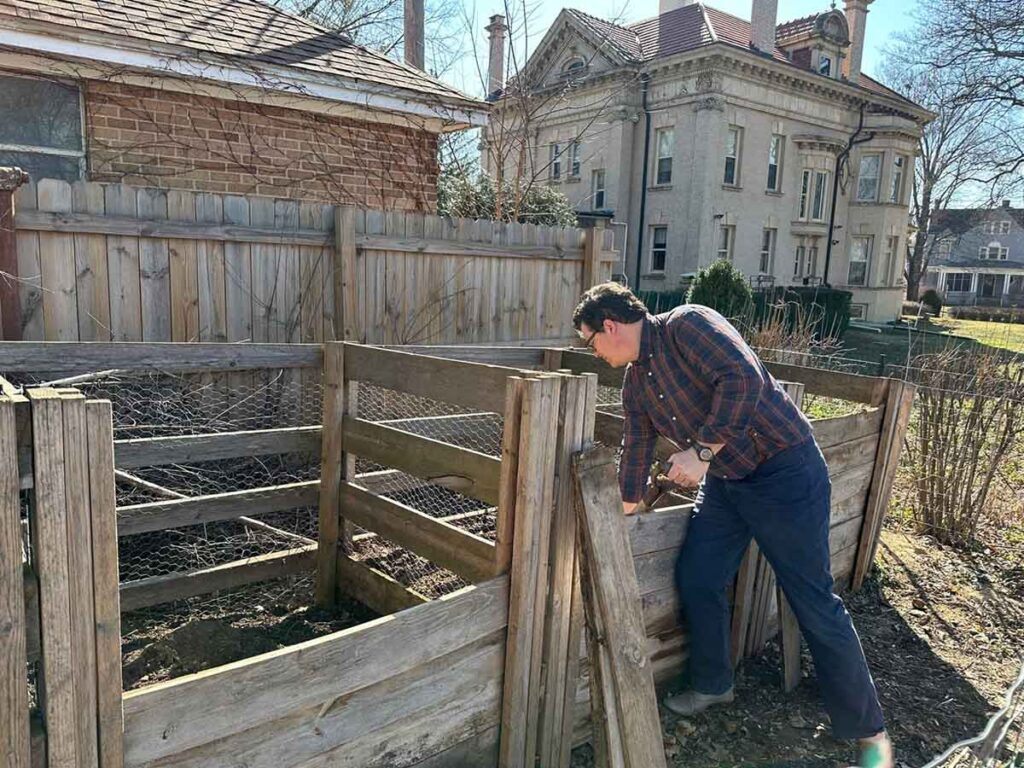
The Cimas use a three-bin composter plus leaf bin. In this photo Jessica is adding leaves to the leaf bin. The leaf bin holds extra dry (also known as “brown”) material that the gardeners can use when needed to balance out the materials in bins 1, 2 and 3.
Here, Jessica adds food scraps to bin 1. With a three-bin compost system, the food and yard waste are first placed in bin 1, then rotated to bin 2. The Cima family has a year-long composting cycle, so the compost spends several months in bin 1 before being rotated to bin 2.
This is bin 1 of the three-bin compost system. Food and yard waste goes first into this bin, where the compost sits for several months before being turned into bin 2.
This photo shows bin 2, the middle stage of the composting process. The compost is rotated into bin 2 after several months in bin 1.
This photo shows bin 3, where the compost goes through its final breakdown into nutrient rich soil. You’ll notice that the leaves and food waste have broken down to the point where they’re no longer visible in the compost.
Gibson Cima uses a shovel to scoop the compost out of bin 2 and into bin 3.
Gibson shows off the gorgeous black compost in bin 3. After a full year going through all three bins, this compost is now ready to spread on top of the garden beds!
This photo shows the leaves piled up in the family’s separate leaf bin. Leaves provide the “brown” high carbon dead plant matter that balances out the “green” high nitrogen food scraps in compost. A good balance leads to healthy compost!
An interview with Courtney Gallaher, Ph.D., NIU Sustainability Coordinator and Associate Professor in the Department of Earth, Atmosphere and the Environment
That’s why this seemed like a great time to learn about the science behind compost and the basics of getting started! We interviewed soil scientist and sustainability expert Dr. Courtney Gallaher to learn more.
Don’t worry if this sounds a little intimidating! You don’t have to be an expert to start your own garden compost. “Composting and gardening should be fun activities,” Dr. Gallaher says. “The best way to learn is to just start.”
Composting can be fun for the whole family! Dr. Gallaher’s children harvested potatoes grown in big containers of compost.
Why is it good to compost? There are a lot of reasons to compost! From the perspective of environmental sustainability, it offers a positive alternative for what to do with your food scraps.
One of the biggest problems with putting your food in a trash can is that it goes into a landfill. In the landfill, it goes through anaerobic digestion and releases methane into the air, which is one of the most potent greenhouse gases.
If we compost our food, it goes through aerobic digestion instead. Aerobic means the microbes have oxygen to breathe in, so they produce carbon dioxide instead of methane. Carbon Dioxide is a way less potent greenhouse gas, plus the carbon dioxide gets taken up by your plants when they grow, so the process ends up being carbon neutral.
Your compost also turns into nutrients you can put back into the soil. It makes a really rich fertilizer that you can put into your gardens.
As a side note for our elementary audience, what are some other things that produce methane? Are cow farts one of them? Yes, they are! Actually, the microbes in everyone’s guts produce methane that is released through burps and farts, but ruminant animals like cows produce much more because of their diets and the microbes that live in their digestive tracts. Cows have lots of special microbes in their rumens, called methogens, that are good at digesting plant materials that other animals can’t use. The cows absorb the nutrients, and the microbes release methane gas as a byproduct. So cow farts are full of methane, and so are cow burps!
You mentioned that compost is a nutrient-rich fertilizer. What are some of the nutrients in compost, and why are they important? For humans, when we talk about nutrition, a lot of people are familiar with the three macro nutrients: carbohydrates, fats and proteins.For plants, the macro nutrients are nitrogen, phosphorus and potassium. Those are the main minerals without which a plant will die.There are also all sorts of micronutrients that plants need, just like humans have to get other vitamins and minerals.
Compost tends to be high in micronutrients, and also high in nitrogen. So it’s feeding your plants really well by cycling that nutrition from your food or yard waste back into the soil.
How can people get started composting at home?
I’ve worked on composting systems all over the world, and they can be as fancy or as simple as you want them to be. They can literally just be piles of yard waste and food scraps! As you pile stuff up, the bacteria will start to break it down and it will eventually decompose.
There are things you can do to take care of it more intensively that will produce higher quality compost in a faster period of time, though.
One popular method of gardening is called lasagna gardening, where you just create a raised bed layer by layer. On the bottom you put a layer of cardboard over your grass and then you just layer food scraps and grass clippings and leaves a couple of feet high, and then you plant right into that and it just composts underneath your plants. The years I’ve done that I’ve had bumper crops in my vegetable gardens.
How long does it take scraps to turn into compost?
How long something takes to break down depends on the weather (temperature and moisture) and how finely chopped up it was in the first place. I tend to be a fairly lazy composter in my home environment, so if I’m cutting up vegetable scraps in my kitchen, for example, I don’t dice them up to put into my garden compost. I just dump the whole thing in there. Sometimes, if we haven’t gotten to a melon on our counter and it starts to rot, the whole melon goes in. It takes a little longer, but it does break down.
My mother’s a very fastidious composter! So everything gets finally chopped and her compost is much prettier than my compost. But both still work just fine.
What are some other ways to care for your compost?
You can pay attention to the composition of what you’re putting in there. Bacteria need a specific ratio of carbon to nitrogen to do their best job composting.
Food scraps, grass clippings, green things – all that tends to be quite high in nitrogen. High carbon things tend to be brown leaves, leaves that you’re raking up at the end of fall, or weeds that you pulled out of your garden or whatever scraps you clean up from your garden.
So if your compost isn’t acting the way you want it to – if it smells bad or it’s too wet – you can add more of one type or more of another, and tweak the composition. If you alternate layers – food scraps, plant clippings, food scraps, plant clippings – that just kind of naturally takes care of it.
Even though composting has a lot of chemistry to it, you don’t need to be a chemist to compost! You can just tweak it as you go along.
What’s OK to put in compost, and what isn’t?
As far as food scraps that are acceptable to put into home compost: fruits, vegetables, plant scraps, coffee grounds, eggshells, those sorts of things are fine.
You’re often advised not to put dairy products or meat products into your compost only because they can attract animals. It’s not that they’re not compostable. They are definitely compostable. But in a home environment, experts often advise you not to put them in, whereas with municipal composting systems, everything goes in. But again, I’m kind of a lazy composter, so like, if dairy’s been mixed into a meal, it just goes in the compost.
I hear that compost has to get up to a certain temperature. How hot does it get and why is that important? It doesn’t actually have to get up to any specific temperature – it just does! Because when the bacteria are doing their jobs, they’re releasing energy, and the energy creates heat. How hot it gets really depends on how attentive you are to your compost and therefore how active are the bacteria in the compost.
It also depends on how big your compost pile is. Big municipal compost piles might get up to about 170 degrees Fahrenheit, whereas your home composting pile might get up to 120 or 130 degrees.
What else is important to make sure your compost is healthy? Aerating your compost is important because that’s giving oxygen to the bacteria. Aerating just means turning the compost to give it more air, whether you have a barrel, a pile or a three-bin system.
What options are there for people who don’t have room for a composter in their yard?
For people who can’t compost at home, a lot of cities now have composting programs andthey’re able to use that in their city parks or gardens, or they sell the compost to customers. In DeKalb, residents can add food scraps to their yard waste bins during collection season.
Another option is vermiculture – worm composting that can be done indoors in a bin.
Worms! Tell us more about worms, please.
Worms are amazing. I was terrified of worms as a child, but I’ve come to appreciate their role in the garden.
In most healthy compost systems, you’ll find some worms that have found their way in because it’s nutrient rich, and the worms have to eat that organic matter as their food source. Then they’ll concentrate it and poop it out as worm castings – and those are super dense little doses of fertilizer.
Worms also help to aerate the soil, to turn it and provide oxygen. And they also create these tiny channels that water can run through. So that again helps to water your compost system or allow water to drain into your garden soil and to move nutrients around.
Vermicomposting is a really fun science project to do with kids and a very effective way of home composting. You can even do it inside in the winter.
What’s happening on NIU’s campus with composting?
NIU’s Edible Campus has a vermiculture system set up, and they’re also raising funds March 20-21 to build a three-bay composter. So those two types of composting will be happening, providing a significant portion of the compost needed for the NIU Edible Campus gardens.
Then long term, one of the things that we’re trying to set up is a food waste composting system for all of campus dining. NIU produces about 700 pounds of food waste per day. And that’s mostly the food out of campus dining that people didn’t finish on their plates – because campus dining’s already doing a good job trying to avoid food waste in the back of house.
Likely for logistical reasons, so we’re not transporting a lot of food waste across campus, they would go into an electric biodigester system. These systems are aerobic (there’s that word again!), so they use oxygen, they’re thermophilic, meaning that they get really hot. The electric compost system is designed so that the food waste passes through it in about two days instead of 60 days.
What else should we know about food waste and compost?
About 40% of food produced in the US is wasted. Some of it is wasted, of course, on the production side. Sometimes it’s left in farm fields. It’s wasted in grocery stores because produce they don’t sell gets put in a landfill. But there is just an astronomical amount of food waste coming out of households, and even people who try to be careful still have food waste. So composting is a really sustainable option for disposing of food waste.
I love compost and I love talking about compost because I have two degrees in soil science. I think soil is everything – it literally allows us to live!
But you don’t have to know anything about soil or anything about gardening to be a successful composter. You just have to try it, and the system can be as precise or as messy as you want it to! Eventually the food will all break down.
Lesson for All Ages: Make a Worm Composting Bin
Making and feeding a worm composting bin is a great activity for pre-school through grade 12. Check out this activity from kidsgardening.org for detailed instructions and materials list. It’s also great to try at home!
Resources for Composting at Home
Here are a few of Dr. Gallaher’s favorite resources to help you compost at home or learn more about the science behind composting.
The Rodale Institute: Why Compost – The Rodale Institute is one of the founding research institutes of modern organic farming. Check out their website for more details on why and how to compost.
The Rodale Institute: Backyard Composting Basics – When Dr. Gallaher interned with the Rodale Institute after college, she was helping farmers in Senegal set up composting systems. But the institute also offers instructions for how to compost right in your own backyard.
U of I Extension: How to Begin Composting Webinar – The University of Illinois extension is a great resource for gardening, composting and soil health right here in Illinois! Check out their website for instructions and webinar recordings.
Scientific American: How Food Waste Turns into Huge Amounts of Greenhouse Gases – By following specific foods through their entire life cycle, researchers have determined just how much wasted food adds to emissions through phases such as harvest, transportation and disposal. Check out this article from Scientific American to learn more.