
Composting in Action – A DeKalb Example

A compost tour with Curator of the NIU Pick Museum of Anthropology Jessica Cima

Spring is here, and our gardens are waking up. NIU’s Edible Campus program is raising funds to build a composter, and here at NIU STEAM we’re planning a new sustainability careers summer camp.

That’s why this seemed like a great time to learn about the science behind compost and the basics of getting started! To learn more, we turned to Jessica Cima, the curator of NIU’s Pick Museum of Anthropology and an avid home gardener. Jessica recently presented at one of our STEM Cafés about gardening, preserving food and sustainable food systems. She and her family grow and preserve much of their own food – and the family’s three-bin composter is a central part of the garden.

Composting is a family activity for the Cimas. The Cima family shared some photos with us to show what a compost system can look like, and what compost looks like at each stage. Check it out!

To learn more about the science of composting and get resources for starting your own composting system, check out our interview with NIU Sustainability Coordinator Dr. Courtney Gallaher

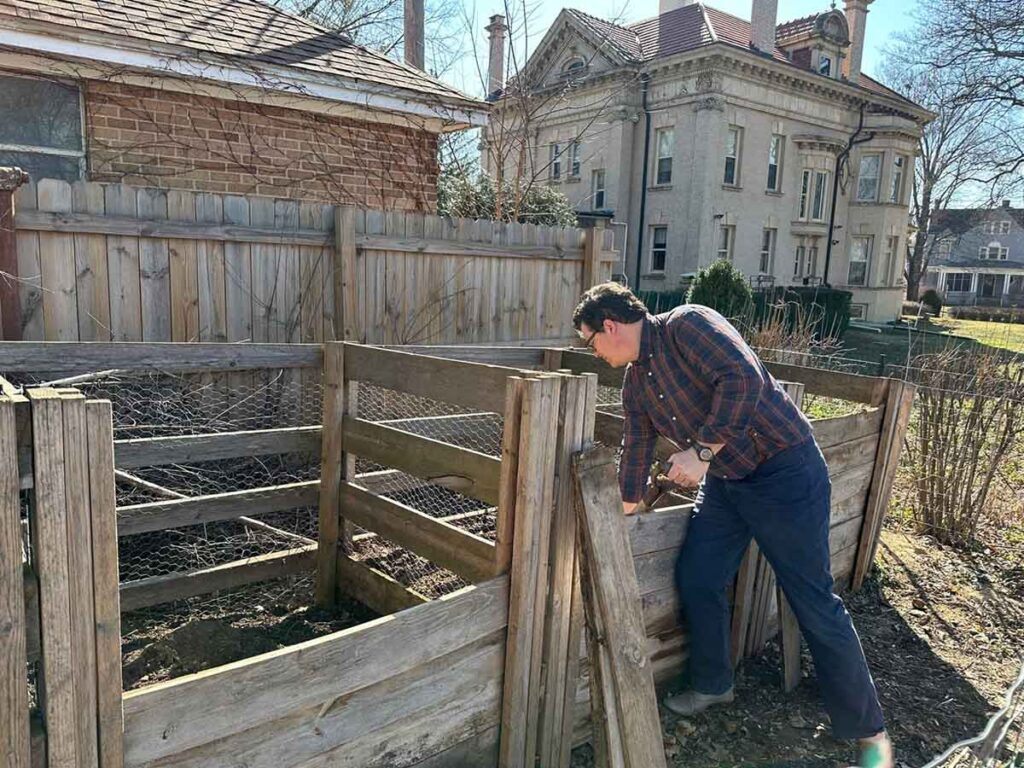
The Cimas use a three-bin composter plus leaf bin. In this photo Jessica is adding leaves to the leaf bin. The leaf bin holds extra dry (also known as “brown”) material that the gardeners can use when needed to balance out the materials in bins 1, 2 and 3.
Here, Jessica adds food scraps to bin 1. With a three-bin compost system, the food and yard waste are first placed in bin 1, then rotated to bin 2. The Cima family has a year-long composting cycle, so the compost spends several months in bin 1 before being rotated to bin 2.
This is bin 1 of the three-bin compost system. Food and yard waste goes first into this bin, where the compost sits for several months before being turned into bin 2.
This photo shows bin 2, the middle stage of the composting process. The compost is rotated into bin 2 after several months in bin 1.
This photo shows bin 3, where the compost goes through its final breakdown into nutrient rich soil. You’ll notice that the leaves and food waste have broken down to the point where they’re no longer visible in the compost.
Gibson Cima uses a shovel to scoop the compost out of bin 2 and into bin 3.
Gibson shows off the gorgeous black compost in bin 3. After a full year going through all three bins, this compost is now ready to spread on top of the garden beds!
This photo shows the leaves piled up in the family’s separate leaf bin. Leaves provide the “brown” high carbon dead plant matter that balances out the “green” high nitrogen food scraps in compost. A good balance leads to healthy compost!

This spring, NIU’s Edible Campus program is raising funds to build a similar three-bay composter system in the NIU Anderson Hall Market Garden. Learn more about this project and find out how to support Edible Campus.

Take a look at our interview with NIU Sustainability Coordinator Dr. Courtney Gallaher to learn more about the science behind compost and find links to resources.


Shopping cart0
There are no products in the cart!
Continue shopping
0