
Creating Connections: An Interview with Kristin Brynteson, Ed.D., Director of NIU STEAM
Coming up on June 7, 2024, NIU STEAM and the Illinois MTSS Network are co-sponsoring the STEAMing It Up Conference: Using MTSS to Support Students in Literacy and STEAM.
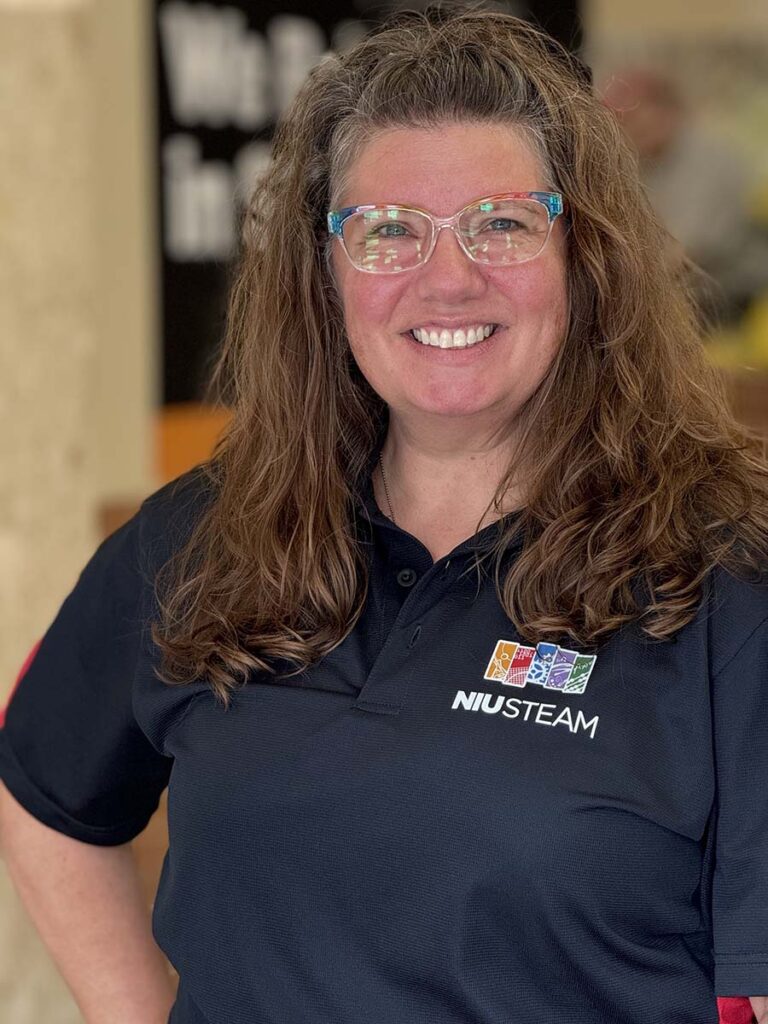
To find out more about what makes this conference special, we spoke with Dr. Kristin Brynteson, director of NIU STEAM.
Why don’t you start by telling us a little bit about what STEAM is?
At NIU STEAM, we think about STEAM as more than just science, technology, engineering, art and math. It’s really about creating a learning environment that’s hands on, experiential, that connects to the content areas through driving questions, inquiry and exploration.
To do this, we apply sound instructional strategies that create engaged learning environments – learning environments where the teachers and students are working together, where the students are taking more of the cognitive load and the lead in learning, and where they’re learning through productive struggle, community connections and authentic problem solving.
How can STEAM learning help educators reach their school improvement goals?
The STEAM learning lens is all about, how do you create personalized learning experiences that meet the students where they are? How can you design learning experiences that provide a low floor of entry so all students can access the content, but also a high ceiling where they can go in the direction that meets their needs and interests? So a STEAM approach can be an additional tool to design a classroom that is truly engaging for students.
Can you say more about how STEAM hands-on lessons work?
Hands on lessons involve students building, creating, experimenting and exploring. The students are doing science or creating prototypes of their own designs. Many times, we start with a challenge or problem and allow students the time to brainstorm ideas, collaborate to build and create. We design hands-on STEAM learning experiences that are centered on driving questions – so we always begin with the question and get students motivated to find the answers or solutions to problems.
Many times, students work in groups so each one can take on a different role and work to their strengths – and the students help and teach one another. Another way to implement hands-on learning is with STEAM stations that students can rotate through with different types of challenges. The students can select a challenge from several choices. It’s about giving a lot of voice and choice to students.
It can sometimes seem overwhelming to teachers to introduce hands-on or project-based learning. Do you have recommendations for manageable ways to bring STEAM learning into the classroom?
STEAM is not about starting from scratch. It’s really about looking at what you’re already doing and finding those areas where small modifications or small ways to reframe things can change the learning environment to be more student driven, less teacher driven. How could it be more hands on or connected to an authentic problem? What are ways you could connect the learning to future careers or maybe connect to other content areas? At the conference, educators will learn about some more specific ways to do this at different grade levels!
Why are you excited that this conference is bringing STEAM and MTSS together?
We’re all focused on the shared goal of student success – and we have different strategies that we bring to the table. Anything we can do to expand our toolkit of strategies is good for students!
I’m excited because we’re learning from each other, looking for those connections between STEAM and MTSS and looking for how they support each other. We’ve not really explored that thoroughly yet, so this is giving us an opportunity to come together and have those “aha” moments along with our attendees. Hopefully, no matter which topic attendees are most interested in – literacy, STEAM or MTSS – they’ll sit in on some of the sessions on other topics and will start seeing connections they might have never thought of.
I’ve heard you talk about “productive struggle” in STEAM education. Can you share more about that?
In hands-on STEAM learning, it’s great to start by letting students explore their strengths and see how far they can go. But then there’s always going to be that moment of struggle – what we call productive struggle. We want students to be curious enough and motivated enough to not give up when they struggle, but to be resilient and use internal and external tools to deal with challenges.
Hands-on STEAM projects can also be a great way to introduce new math or science skills that are just a little beyond what the student has already mastered. Because when students are trying to solve a problem or answer a question they’ve chosen, that math skill has a larger purpose. It offers motivation and takes care of the “why are we even learning this?” question.
What are some of the conference sessions that you’re most looking forward to?
- I’m really excited to learn more about the literacy plan from ISBE. I’m looking forward to understanding more about the literacy plan and what that means for our teachers and students.
- I’m always excited when Argonne National Laboratory representatives comes, so I’m really looking forward to the Argonne session about Artificial Intelligence. I’m excited about their perspective of breaking open that black box of AI so we can find out, how does it actually work?
- I’m also going to attend a lot of the MTSS sessions because that’s new content I’m excited to explore. I’m particularly looking forward to Kari Harris’s session on Building Vocabulary: Strategies for Contextualizing, Rather Than Memorizing. Vocabulary is a huge part of STEAM learning, so I know I’ll learn some strategies we can use in our NIU STEAM camps and after school education programs.
- Of course, I’m also always excited to hear from our NIU STEAM educators – especially Jasmine Carey’s discussion of how to create your own classroom maker space.
What unites all these sessions for me is that we’ll be learning how to help our students become innovative, creative thinkers and problem solvers. It’s about moving the learning up Bloom’s Taxonomy so it’s not just about recall or memorizing – but how can students take this knowledge, make it their own and apply it to something new and creative?
Can you say more about student motivation and why engaging hands-on lessons are important?
Right now, attendance gaps are a big challenge for schools – so engaging students, getting them intrinsically motivated is one important way to make sure students are showing up, paying attention and ready to learn. When students discuss and address actual problems they’re seeing in their community, that answers the “why are we learning this?” question. It empowers students to be more active in their own learning and their own community.
Is there anything else that you want people to know?
At every conference one of the best things that happens is all those hallway conversations – and with this partnership between IL MTSS-N and NIU STEAM, we’re going to have some really unique hallway conversations! We’re bringing together different groups who might not normally be at conferences together, and we can’t wait to see the connections that they make.
Check out the conference homepage to learn more and register!