Every year, Illinois teachers and librarians look forward to the release of the Association of Illinois School Library Educators (AISLE) Monarch Award book list. Comprised of 20 books that are essential reading for K-3 students, this list is the best place to find high-quality, high-interest books to design learning activities around. My favorite book this year is Avocado Asks: What Am I? from Momoko Abe.
This charming narrative about an avocado who wanders a grocery store wondering where they fit in is sure to be a hit with young readers. Is Avocado a vegetable? A fruit? Or a cheese, perhaps? As a STEAM Educator and Librarian, this is the kind of picture book I love. There are so many activities that can be done with this book, as well as great opportunities for discussions around self-acceptance, emotions, and kindness
Computational Thinking & Early Literacy Sequencing
One of the activities I routinely do with K-2 students is to reinforce early literacy sequencing skills through robotics. According to Meadow Glens Elementary School Reading Specialist, Christy Miller, building strong sequencing skills early on is essential to reading comprehension. “Sequencing increases comprehension and the understanding of time in text, how one event leads to another. Strong sequencing skills help students not only in reading, but in writing. Students achieve a deeper understanding of the way stories are told and how the order in which the events unfold is a critical piece of the process.” Pairing early computational thinking instruction with literacy sequencing makes sense because computational thinking is sequencing. To create a robotics program, you need to create a set of instructions, and the order in which we place those instructions is important.
For this activity, students will be using the major events of the book as a guide to create their programming sequence. When using a picture book as a launching point for coding, I usually choose no more than 4 events from a book for students to navigate to begin with. Make sure you have at least one event from the beginning, middle, and end. For this lesson, I selected the following events:
Is Avocado a vegetable?
Is Avocado a fruit?
Is Avocado a cheese?
Is Avocado amazing just the way they are?
Materials Preparation
Before the lesson, print out and follow the instructions to construct the sequencing map. I recommend one map for each group of 2-3 children.
Procedure
If your students have never used a Beebot or Code and Go Mouse, offer opportunities prior to this lesson for free exploration with the robots and then a mini-lesson on the basic coding functions of the robot.
After reading the book, have a discussion around the events in the book. List the events and start asking the students to put the events in the order in which they occurred. What did Avocado do first? Where did they go next?
Show students the 4 events you selected and ask them to order the events from 1-4, the way that they occurred in the text. (You can leave these visible for students who may need a guide while they are coding the robot.)
Explain to students that their coding challenge is to program their robot to follow the order of events in the book.
Model where to start and do a quick review of directional coding.
Place students in groups of 2-3 and model what paired programming looks like. I usually instruct students that only 1 student has their hands on the robot at a time, and the other student is narrating the coding instructions. After 10 minutes have students switch roles. For groups of 3, one student codes the robot, one student narrates the coding, and one student writes down the coding. Switch roles at least three times, so all students have an opportunity to code the robot.
Students can use dry erase markers to write their code on the laminated sequencing map as they move along or the coding cards that come with the robot.
While students are coding, continue to encourage collaboration and communication, making sure all voices are being heard and valued within the group.
Have fun!
Assessment
You can visually assess students’ success by watching the robot successfully navigate the map or by reviewing the written documentation of their code.
No-Tech Modification
If you laminate the maps, students can use dry erase markers to draw arrows to create their program. You could also use programming cards for students to create their programming sequence.
If you are doing this activity at home, and don’t have access to a robot, contact your local library. Many libraries now have educational robots you can check out that would be great to use with our coding map.
Reading about avocados has you thinking about food? Check out NIU’s Foodmaster website for free educator resources linking food and nutrition with math and science concepts.
Watercolor paint is an art medium that has captured the ever-changing landscapes of the world for years. Throughout history artists and makers have taken advantage of this medium’s transparent and luminous qualities to document seasons and biomes and capture the light of day and night. The ease of watercolor paint makes it a great medium for a beginning painter to experiment with or an experienced artist to fully express their creativity.
Watercolor paints come in three main types: pans, tubes or liquid. Pans are made of solid blocks of paint which are easy to use and perfect for on-the-go. (If you’ve ever bought a children’s watercolor set, you were buying pans!) They are widely accessible and can often be found in your local grocery store or an art supply store. Since they’re small, they’re easy to store. One downside of pans is that they can sometimes lack the color variety and pigmentation needed to create the vision of the artist.
Alternately, watercolor tubes are available in a wide variety of colors and do not require water to activate. Tubes tend to work better when working with larger canvases. A disadvantage of working with tubes can be if an artist squeezes out too much paint, the paint can dry up before it’s used up. Tubes also tend to be more pricy and not as portable as pans.
While I like to use all three types of watercolor paints in my artwork, I really love working with liquid watercolor paint in a variety of ways. The magical bottles of vibrant color are ready to use as is or be diluted with water for a lighter color. Liquid watercolors are concentrated and more viscous than water, with a viscosity that’s similar to blood. Artists generally use liquid watercolors with a pallet with wells that help to keep the colors separated. Using a white, plastic pallet allows artists to see the different colors more easily and makes for easy clean up.
There are so many ways for artists to use liquid watercolor!
Below are some of super fun activities you can try on your own
Use a dropper or pipette to put the liquid watercolor on the paper and use a straw to blow the paint around.
Use liquid watercolor to add color to slime instead of food coloring. Liquid watercolor is typically washable!
Add liquid watercolor, water and an Alka Seltzer tablet to a film canister to make a colorful chemical reaction.
Place washi tape on paper before your paint, then lift it off when the paint is dry to make an abstract painting.
Mix liquid watercolor and water into a spray bottle. Spray two or more colors to a piece of paper to see how the colors mix.
We’d love to see how you use watercolors! Share with us on social media by tagging #NIUSTEAM and @NIUSTEAM.
I’m Jess Winn, and I like to call my series of blogs Winning Ideas! This episode’s winning idea? Pumpkins aren’t just for little kids! Keep reading for a fun way to bring fall hands-on activities into your secondary classroom.
I’m so excited that spooky season is officially here! (Fall for everyone else.) We’re experiencing the final days of harvest festivals, the temperature is dropping, there is talk of pumpkin carving and costumes, and students are starting to feel the itch for a new project. We have all experienced that! We start our school year off, things start feeling like they are in a flow, and then we look for ways to enhance our student’s academic experience.
Many secondary educators really dig into curriculum, pushing through the massive list of standards outlined by the state boards of education. Yet sometimes we push so hard we forget that there is so much joy to be had in offering students a new way to access learning. So, take a sip of that pumpkin spice and let’s dig in!
We have all seen the videos of elementary teachers with their cute projects, but why can’t we do those at the upper levels? Consider the experiment where you have a pumpkin – let’s say it’s a small pie pumpkin – and you allow the class to carve a face in the pumpkin. If you leave the pumpkin with its seeds in a sealed glass jar with about 3-4 inches of soil, that you have carefully misted before you sealed…what conversations could that spark surrounding your topic?
Could your students draft short stories regarding the fate of your pumpkin friend? Could you discuss the historical ramifications of food cultivation? Maybe, you, as a class, are gathering data and charting the changes over time, as well as explaining to your class the process of decay and the energy cycles that exist. Or better yet, you are creating a formula using the math you are teaching in class to predict, based on research, the amount of time it will take to sprout new pumpkins.
The options to bring fun projects into your classroom are there, they are valuable, and they tie in with your curriculum. I know the overwhelming stress of ensuring your students are prepared to score well on standardized tests is looming, but you might be surprised – a little fun in your classroom can spark a lifelong passion for learning. It can lead to deeper conversations, and it can grow a connection where one did not originally exist.
So go forth and experiment with your pumpkins! You will grow not only a wealth of interactive knowledge, but also pumpkin starts for each one of your students to take home and grow.
Necessary Materials
Small Pie Pumpkin with its seeds still intact.
Knife or other carving tool.
Large Glass Jar with a tight-fitting lid.
Soil, 3-4 inches in the bottom of your jar.
Water.
Tape, preferably one that seals well like duct tape.
Instructions
Carefully carve a face in your pumpkin. Be sure the seeds stay mostly inside the pumpkin throughout the process.
Add about 3-4 inches of soil to the bottom of your jar.
Moisten your soil so it is decently damp but not wet or soggy.
Gently place your pumpkin on top of the soil.
Seal the jar with tape. This is to contain the mold spores – because it will mold!
Set it in a place with plenty of light, but where it will not be jostled around too much.
Observe and create!
Lesson Suggestions
Math – Formula for a sprouting date. Research about how long it takes to grow pumpkins and build a formula out from there. You can even go back in and calculate your error.
Math/Science – Data collection on the phases of decay and development. Collect qualitative data about the pumpkin’s appearance, convert that into usable numerical data and graph your results: appearance (normal, molded, fully decayed, sprouts) vs. number of days.
Science – A discussion point in energy cycles. Also, an experiment in decay rates and reasons for decay. (You can do multiple pumpkins with different environments to test efficacy of fertilizers, requirements for decay, etc.)
English/Language Arts – Create a short story surrounding the fate of the pumpkin king (or queen). Discuss thematical elements, grammar and spelling, creation of a fiction world, and other plot-based content.
History – Discuss the idea of food cultivation, genetic modifications, and impacts of food cultivation on the western world.
Don’t forget to share your projects with us! Tag #NIUSTEAM and @NIUSTEAM for a chance to be featured in our weekly newsletter. Do good things, be good people, and make yourself better than the day before.
A couple weeks ago, the NIU STEAM PD team met for a blog workshop. During the workshop, we started sharing our stories about a moment from our childhood that inspired our love of STEAM. All of us could point back to a moment, event or experience that sparked a lifelong interest in STEAM. It was a fun conversation and got me thinking more about the power of the spark.
At NIU STEAM we have built programing around this idea of sparking an interest. As part of our STEAM framework, we have three tiers of impact that drive the purpose of our programs. The first tier of impact is Inspiration. What that means is, our programs, events and activities in the Inspiration tier are designed to get participants asking questions and wanting to learn more – to spark an interest. I like to think of this as the Spark tier. In fact, Find your Spark is the tagline for our largest Inspiration event of the year, STEM Fest! This year, STEM Fest was on September 30 and was a huge success!
At STEM Fest what do we mean when we say, Find Your Spark? We mean come and be inspired. While you are there, be curious about the world around you and open to where that curiosity will take you. Find what interests you and inspires you to learn more. To help attendees find their spark, we fill the center of campus with hands-on activities to explore and amazing people to talk to. There is something interesting to do and someone interesting to talk to around every corner. The goal of STEM Fest is to showcase the wide world of STEAM. When we say there is something for everyone, we really mean it. The entire purpose of the event is to get attendees saying. “Oh! I never knew that!” or “Wow, I want to learn more about that!” or “I want to do that when I grow up!” STEM Fest is not about making sure everyone develops a deep understanding of every STEAM concept presented. It’s about the spark. We want everyone to leave with a deep desire to learn something more about something new.
We know that a 10-year-old who attends STEM fest will not leave the event with the knowledge and skills needed to build their own Mars Rover. However, that 10-year-old may have had their first encounter with a rover built from scratch by engineering students – and the may decide they want to do that someday. They then go home wanting to learn everything they can about robotics and coding so they can build their own in the future. It sparked a new interest. A high school student might have stopped by one of the booths and had a conversation with a faculty member doing research on water. Did they leave understanding the full impact of microplastics in our water systems? Probably not. But they may have become more aware of their impact on the environment and learned about careers in water research they didn’t even know existed. That conversation helped them decide what to do after high school. It sparked an interest in an exciting new career path. An adult visiting STEM Fest might have stopped by a booth in the Health and Wellness Hall and learned about the connection between diet and hearing loss. That new information sparked a desire to better understand the connection between what they eat and their overall health. They were inspired to learn more and make some changes.
In my 14 years of STEM Fest, I have witnessed these sparks over and over again. You can see it when it happens. Sometimes it’s subtle. The nod of the head. The raise of an eyebrow. Other times it’s big! A whoop or a wow! A laugh or a clap. You can see the gleam in the eyes when someone finds their spark. These moments, conversations, and experiences may be fleeting, but they have the potential to make a lasting impression. Finding your spark is about being inspired to learn more and do more. Even small sparks can be life altering. Just like how the PD team talked about a moment that inspired our love of STEAM. A moment can spark a lifelong interest. But remember, finding a spark is not just for the young. It’s for all ages. Anyone can experience a spark of inspiration, and sometimes it’s found in unexpected places.
So, go out there and find your spark! You never know when inspiration will find you. It might be at next year’s STEM Fest or maybe at a future STEM Café. It could be while sitting on your couch watching an interesting YouTube video, reading a book or listening to a podcast. You might be inspired by a fascinating plant you find while walking in the woods or by a new work of art you discover while visiting a museum. It could even come from a chance conversation with an interesting stranger at your favorite coffee shop. A spark of inspiration can happen at any time, in any place, and a spark is a catalyst for change. You just need to stay curious, ask questions and be open to new experiences. Encourage the young people in your lives to do the same. You never know how one spark will inspire you.
Many of us still remember those moments of learning and creation that were our childhood “STEAM sparks.”
We’re always learning here at NIU STEAM. Recently, we decided to learn how to make our blog writing even better. So we called up Beth Schewe, a writer here in the NIU Division of Outreach, Engagement and Regional Development, to run a blog-writing workshop. We brainstormed, we looked at good blogs, we decided we wanted our blogs to be authentic, to capture our unique voices and points of view, while also sharing our expertise and giving insight into the learning process.
We thought it would be a good learning experience to write a blog post together, but where should we start? It turns out we each had a story of a moment we felt a STEAM spark – that moment we were inspired to become an artist, an engineer, scientist, educator or creator. These memories reminded us why we do this work – because learning experiences, both positive and negative, can impact a young person in ways that reverberate all through their lives.
Papier-mâché, by Stephanie Dietrich, NIU STEAM educator
I am 6. I’m in my neighbor’s kitchen with friends from my school. It’s our monthly Brownie meeting. Today we are doing papier-mâché. I am so excited. I’ve seen the bowl that Molly’s mom made. Molly is my best friend. We are all surrounding the kitchen table. The chairs have been moved so we can stand at the table. In front of each of us is a balloon and a bowl of glue. Paper strips crowd the center of the table. The kitchen smells like glue and Molly’s mom’s perfume. She wears a lot of it.
I’m dipping strips of paper into the bowl of glue. My hands are slippery with glue, but it doesn’t bother me. I like it. It makes me happy to pull the strip out and let the drips of glue drop back into the bowl. Then I carefully place the strip along the balloon and smooth it out. I don’t like when there are wrinkles in the paper…I like it when it’s completely smooth.
We’re laughing. This is a messy process, there is glue everywhere, including on Molly. We try to wipe our faces with the backs of our hands because the glue will get in your hair, and that doesn’t feel good. I grab another strip of paper, slowly dip it into the glue, and slowly pull it back out. One of the girls doesn’t like the feel of the glue on her hands. She starts to cry. Molly’s mom helps her to the kitchen sink to wash her hands. She won’t finish her project. But I know I will finish mine. I can’t wait to see what it looks like when it dries and I can pop the balloon. I know I will keep it on my dresser in the room I share with my two sisters, but I don’t know what I will keep in it. This is the first memory I have of making something with my hands.
I’ve never stopped creating since then.
In Spite Of, by Jess Winn, NIU STEAM educator
“You will never be good at science.” The burn of being told at a young age that you WON’T be good at something can impact students in one of two ways. Direction one: you close students off from engaging with something that they potentially could truly love. You stifle that engagement from a young age, forcing them to think negatively of themselves and a whole realm of understanding. Direction two: students become “in spite of” students and they develop a passion to be better. So where did I find my STEAM Spark? I was an “in spite of” student. I dove in headfirst and developed a passion for science, technology, math, art, and engineering because I had been told I would never be good enough.
Fast forward 10 years – my first time in the classroom facing a large group of 7th graders. I hear comments like, “I’m not good at science” and “I hate science” and I’m transported back to my first day of science class. I have an opportunity to change their minds and show them they’re good enough.
That first day we talked about measurement and made fudge. We engaged in deep conversations about the benefits of the imperial vs. metric systems. As the year went on, students came to class asking about topics they had heard in the news and social media. We investigated everything from genetically modified animals to green energy. Suddenly, the conversations changed from “I’m not good at science” and “I hate science” to “I want to study ___ when I grow up.” We changed the narrative without condemning them to be “in spite of” students. In a world full of impressionable students who might remember our words for years to come, be the spark for students to develop their loves and passions on their terms.
Get on the Boat, by Beth Schewe, writer in the NIU Division of Outreach, Engagement and Regional Development
I remember building a boat in high school physics class, out of nothing but cardboard and Elmer’s glue. Then we put that boat in the school swimming pool, climbed in, and rowed back and forth. When we first heard about the assignment, it seemed impossible. No tape, no paint, no plastic or metal. Only cardboard and water-soluble glue. My partner and I had not done so well on our previous project and knew we had to ace this one. So we recruited my next door neighbor, who was an engineer, to help us out.
He guided us though the process with questions: What shape do boats usually have? Which cardboard box could you start with that already looks a bit like a boat? Why do you think that shape works well for boats? We got a large refrigerator box, make as few cuts as possible, folded the sides to double up the cardboard for added strength, and glued that cardboard in place. We did the water displacement calculations, then tested it out in the pool – and it floated! Our rowing was a little rusty, but our boat lasted ten minutes in the water without a single leak, and we rowed the second most laps of all the teams.
As we watched many of the teams’ boats sink immediately upon being placed in the water, physics and engineering lessons hit home that stay with me today, such as: form needs to follow function. Just because it looks cool doesn’t mean it will work. Calculate, create, test, and refine – we tested our boat before the big day, and that paid off. It was the engineering design cycle in action. It doesn’t surprise me that one of my team members became an engineer after that experience! Even though I pursued a career in English and writing, the lessons I learned from that project are things I use today.
Fearless Childhood, by Dr. Kristin Brynteson, NIU STEAM director
I remember exploring on family camping trips. Every summer since as early as I can remember my family went camping up in northern Wisconsin. Six of us packed into an old station wagon pulling a pop-up camper. We spent weeks out in the woods and on the water. As feral children in the camp sites, we were left to our own devices to explore, play in the mud, climb on the rocks, swim in the lakes and rivers, and build strange contraptions. All of these experiences, from seeing the aurora after a Fourth of July fireworks show to listening to park rangers talk about turkey vultures, made me voraciously curious about the world around me.
This continued as I got older. The camping trips may have ended, but the summer of feral children continued. As latch key kids, my siblings, friends and I continued to explore and experiment. In our neighborhood, we were the kids building haunted houses and hosting talent shows with props and special effects. We invented crazy concoctions in the kitchen because plain old peanut butter and jelly sandwiches were boring.
As I look back, it is hard to point to one clear event that sparked my interest in STEAM or led me down this path. Instead, it was a childhood lived full of fearless curiosity and experimentation coupled with the freedom to explore, make mistakes and get messy.
What’s your STEAM Spark story?
Email us at NIUSTEAM@niu.edu and share a story of how your interest in STEAM was sparked. We might just share it in a future blog.
On Wednesday, Oct. 4, 2023, we’ll be hosting a STEM Café at Fatty’s with Andy Jeon, PhD, NIU assistant professor of marketing, and David Gunkel, Ph.D, NIU professor of media studies. NIU STEAM educator Judy Dymond interviewed Professor Jeon to learn a little more about artificial intelligence and get a preview of the October café.
There has been much conversation among academics and companies about ChatGPT, now in its 4th Generation. Tell us about this emerging technology. What is ChatGPT? How does it work?
ChatGPT (Generative Pre-trained Transformer) is based on the transformer architecture. Just like a ‘Transformer’ robot shifts shapes, the machine learning ‘transformer’ shifts attention to different words, especially when trained on gigantic data, to understand language deeply. Each version of GPT, including the 4th generation (ChatGPT4), improves upon its previous versions through refined architectures, larger model sizes, and advancements in training techniques on vast amounts of text data.
How do you see this technology evolving? What do you think ChatGPT will look like in the future?
We need to be very vigilant and watchful about the next generations of this technology. There are two issues – 1) a technical concern about its potential applications – what are the practical uses of this technology? and 2) an ethics issue connected with people’s use of this technology. Many companies are afraid they are getting behind and wondering what they need to do to keep up with other companies that are beginning to use it. But they’re also feeling somewhat cautious about this product, especially regarding the line between what ChatGPT can do and what it should avoid doing.
What are potential users are saying about this technology?
The first question that potential users are asking is, “Where can this technology be applied?” There is this market interest, but also the ethical application issue. It is cutting-edge technology and can have novel applications. Right now, however, there is the transparency issue. If there is a news article, for example, should it be disclosed that it was generated by AI?
When it comes to an advertisement for an election, for example, companies such as Google are planning to enforce disclosure – that Generative AI generated the advertisement.
The final outcome of ChatGPT artificial intelligence can be a very creative art piece. For example, in South Korea, there was a claim that some artists used ChatGPT for web cartoons. Many readers in South Korea are outraged by this. The object of a cartoon is for people to enjoy the story and the humor. However, people seem to draw the line and think it is important to reveal that AI created the humor.
ChatGPT is also used for marketing campaigns, and it is important that marketers know how it is perceived. For example, if it were to be used for a blog article, if it is not disclosed that AI generated it, at some point people will distrust the content – even if it is generated by a human – because they assume that the internet is polluted by ChatGPT-created content.
Users need to come up with their own ideas for using the technology that meet their specific needs. To do this, companies need to thoroughly understand how generative AI like ChatGPT works. Then, the companies need to finetune the use of ChatGPT for their goals.
What conversations are you having with your students about ChatGPT?
Our minds are adjusting to this technology. If we rely too much on this technology, our thinking will be changed. Users will not be using their own imagination and all parts of their human brain. The human’s capacity for creative thinking may be compromised. If ChatGPT says that it is creative, how do we know if it is creative or not creative?
ChatGPT is developing based on new data. But, imagine that the Internet is full of generative AI created contents, then, ChatGPT is trained on the content it created. The possibility is that ChatGPT will be in a feedback loop, reinforcing its own patterns and biases. It would postpone the benefit if the whole internet were polluted by AI content which ChatGPT is trained on. So, what will ChatGPT 20 look like if it keeps training on its own data?!
To ensure the progress, it needs to be updated with fresh insights from human creativity.
What are some concerns and cautions for users?
The more I use generative AI, the more I am scared.
For example, if ChatGPT says that a piece of poetry I wrote is creative, how does it know if it is creative or not creative?
Philosophically, at some time in the future, there will be a humanoid that has no physical and mental difference with humans. The only difference will be its artificial origin. In this situation, what will the other difference be – the soul, which may be a matter of belief rather than empirical evidence.
What if we have a robot that gets a conscience? How do we react? I ask this question to my students in my class: would you like to see a customer service chatbot that seems to be self-aware? The answer is mixed.
With roles in patient care, research and drug development, there are many career paths in the pharmacy profession.
By Brandon Hansknecht, Pharmacy Student at UIC College of Pharmacy, Rockford
The University of Illinois Chicago College of Pharmacy, Rockford Campus, has been a regular exhibitor at STEM Fest and we’re excited to have them back this year! In celebration of World Pharmacist Day (Sept. 25), we asked third year pharmacy student Brandon Hansknecht to share a little bit about the pharmacy profession. Keep reading to the end for a pharmacy research activity for high schoolers or older students!
The pharmaceutical side of healthcare has played a major role in healing ever since humans discovered they could use products from their environment (namely plants) to enhance the outcomes of the sick. Pharmacy as we know it today started taking shape around the Industrial Revolution, when medications began being produced in mass quantity. There were already ‘druggists’, or apothecaries, at the time, and it seemed intuitive to leave the drug experts in charge of all the manufactured medications. Eventually, this pushed the pharmacy profession to become specialists in medication dispensing and compounding, which is still very much a part of the profession today.
Around the early 1920s, the desire to advance the pharmacy profession by advancing the education requirement was becoming a popular idea among pharmacists. A group known as the American Association of Colleges of Pharmacy (AACP) developed a pharmaceutical curriculum which included courses like chemistry, biology, physics, physiology, pharmacology, and botany with miscellaneous courses like pharmaceutical manufacturing and retail sales operations. Then, in the 1930s, another group called the American Council of Pharmaceutical Education (ACPE) created a standardized four-year curriculum that became nationally adopted. Moving into the 1940s, the curriculum was recommended to be lengthened to six years, and graduates would be awarded a Doctorate of Pharmacy, or PharmD, instead of a bachelor’s degree. This change would allow pharmacists to be directly involved with patient care, with the goal of optimizing safety and efficacy in medication therapy. Then, in the 1980s the American Pharmaceutical Association (APhA) proposed that the PharmD degree become the bare minimum educational requirement for pharmacists. This proposal was eventually widely accepted, and along with the new education requirements came new roles, responsibilities, and opportunities for pharmacists to involve themselves in patient care.
Currently, outside of retail pharmacy, pharmacists have the opportunity to obtain clinical residencies in order to practice in many different areas of healthcare, including the emergency department, critical care department, oncology department, transplant department, anticoagulation department, mental health department, etc. These clinical positions allow pharmacists to actively reconcile all medications that patients take and make recommendations that address potential interactions, improve compliance, ensure safety, and hopefully improve patient outcomes. Having a medication expert on the medical team is useful for everyone because it allows pharmacists to worry about medication therapy, and other healthcare professionals to improve patient care in their own respective areas, ultimately leading to better patient outcomes all around.
Pharmacists can also find jobs in the pharmaceutical industry within areas like medical affairs, regulatory affairs, clinical development, research, etc. There are many moving parts in the drug development process, and pharmacists have skills that can make this process efficient, cost effective, and safe for the patient. Industry jobs usually require a fellowship after graduating pharmacy school and these usually last about one or two years, similar to a residency. One major differentiating factor of an industry job is that you are helping patients at a macroscopic level, as opposed to the personal level of a clinical or retail position. However, should a pharmacist not be interested in either the clinical or industry route, there are also careers in academia, business, insurance, and of course, the traditional setting of a community pharmacy.
Pharmacy Activity
Try this at home or in the classroom! This activity requires some understanding of chemical structures and is recommended for high school students or adult learners – especially in a chemistry class. It’s a great example of how chemistry impacts everyday life.
1. Pick a class of medications. (There are numerous classes of medications, but a few common ones are listed below for convenience)
Nonsteroidal Anti-Inflammatory Drugs (NSAIDs)
HMG-CoA Reductase Inhibitors (‘statins’)
Angiotensin-Converting Enzyme (ACE Inhibitors)
Beta-Blockers
Corticosteroids
2. After you choose a class of medication, pick two or three medications within that class to do this activity.
NSAIDs
Ibuprofen
Naproxen
Diclofenac
3. Search the chemical structure of that medication
Type “xxx chemical structure” in the search bar
4. Once you have pulled up the chemical structure for two or three different medications, look for similarities and differences in their structures. How medication works in the body is all dependent upon their structure, and simple structural differences can be responsible for drastically varying effects within the body. Learning the structure-function relationship of medications and the body’s physiology is an important part of drug development, and the designing of new medications.
Art doesn’t always turn out the way we want the first time. Those challenges help the learning happen.
When making art, oftentimes the natural urge is to replicate exactly what we see. While copying art seems counterintuitive to the creative mindset expected from an artist, art imitation has been around as long as art itself. In art education, young artists often learn and explore art principles and techniques by imitating experts.
But this can also be a stressful place for young artists because people are people, not photocopiers! Often, if their art doesn’t look exactly like their subject, students feel like they’ve failed. At NIU STEAM, we approach art through an iterative process we refer to as our engineering-design cycle. The cycle promotes creativity, discovery, critical thinking and a growth mindset that encourages learning through productive struggle leading to solutions that overcome failures.
National Arts in Education Week is celebrated each year beginning the second Sunday in September. According to the website National Day Calendar, National Arts in Education Week celebrates transformative powers of creative skills and recognizes the impact of arts education and how it equips young people to succeed in all areas of life.
This week will also mark the first week of the 2023-24 school year for our Barb City STEAM Team after school program for middle school students attending DeKalb School District 428. Students meet daily after school on the campus of Northern Illinois University to explore STEAM concepts such as maker activities, art and digital media, science, engineering and robotics.
Art education is one of the many ways our Barb City students practice communication and exploration. Students regularly experiment with their own creativity and gain mastery of art skills and techniques, even when on the first attempt their artwork doesn’t turn out exactly how they imagined.
Last year, Barb City students in painting class learned the skills of persisting through their discomfort and reframing their expectations by creating a non-representational, abstract painting. After looking at some abstract expressionist artists, students were challenged to make their own painting, without using a brush. Using only pallet knives, they focused on how acrylic paint applied, mixed, and bent on canvas.
They experimented with principles and techniques such as color theory, mark-making, hand pressure, paint consistency, and applying and removing paints. And they learned to struggle with the hardest question of all: Is my painting done? In the end, our Barb City friends gained an amazing sense of ownership of their painting and a newfound confidence in themselves as artists.
NIU STEAM is now accepting applications for the Barb City After School Program for students attending DeKalb School District 428 middle schools. To learn more, visit go.niu.edu/BarbCitySTEAMTeam
Try It at Home
To make your own abstract art, you’ll need the following materials:
8 x 10 canvas
acrylic paint
cornstarch
pallet knives
painting pallet
large paint brush
blow dryer
napkins
water cup
smock
table covering
Pick a paint color for the background and cover the entire canvas and edges with the paint. Spread the paint in a variety of directions, using an X motion at different angles and sizes.
Set your painting aside and allow time for it to dry. To speed the process, try using a blow dryer.
Set up your paint pallet by placing 2–3 additional paint colors along with your background color onto your pallet. Try choosing colors next to each other on the color wheel.
Add a little bit of cornstarch to your paint. The more you add, the thicker the paint will become.
Using your pallet knife, select one color and begin spreading it on your canvas in different directions. It should feel like you are spreading butter on toast.
Repeat the above step with your remaining colors on your painting pallet. Try to make different size marks and don’t over-blend!
Take a step back and review your painting. Does it need more of any color? Does it need you to take some paint off in any spots? Remember: This type of painting is about color, mark-making, and texture.
Once you have the painting the way you like it, set it aside and allow time for it to dry completely.
Celebrate your accomplishments and do not forget to hang your artwork up for others to enjoy.
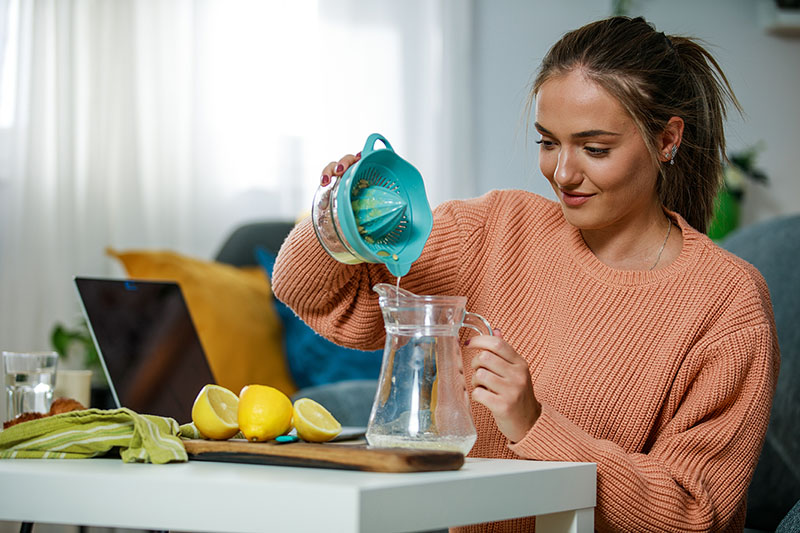
August 29 is National Lemon Juice Day, not to be confused with National Lemonade Day, celebrated annually on May 5. Lemon juice is the liquid extracted from a lemon when the pulp of the fruit is smashed. While in the U.S., lemon juice is probably best known as an ingredient in lemonade, it’s used for a variety of other purposes, including culinary, health, hygiene, and cleaning.
But our favorite use of lemon juice, of course, is as a teaching tool! Here are some fun lessons to teach about acids and bases, chemical reactions, and more.
Lemon Science Experiments: These experiments are great for home or the classroom, and they only take five to ten minutes. Designed for preschoolers, the lessons are also fun for older kids.
Lemon Juice Invisible Ink: Is there anything more fun than writing secret messages in invisible ink? If you have an iron and a lemon, you can practice this spy technique.
Oxidation Transformation: This middle school lesson from our FoodMASTER curriculum uses lemon juice to teach students about enzymatic oxidation. Keep reading to learn more about this lesson and FoodMASTER!
FoodMASTER: Using Food to Teach Applied Mathematics and Science
Lemon juice is just one of the ingredients found in the FoodMASTER curriculum, an education program designed to bring real-world learning opportunities to students by combining food with math and science concepts. Students in grades 3+ learn about measurement, numbers and operations, algebra, geometry, biology, chemistry, nutrition and health, problem solving and more while having fun with food.
One of my favorite FoodMASTER lessons, Oxidation Transformation, is a middle school lesson in which students use lemon juice to learn about enzymatic oxidation. Have you ever sliced an apple for a child and watched it turn brown before he or she got the chance to eat it? It sure doesn’t look very appealing when enzymatic browning sets in. With this lesson, students learn about enzymatic reactions and how they can use antioxidants like vitamin C (found in lemon juice) to reduce the browning damage that causes an apple to look unappetizing. Students also explore the idea if antioxidants can help prevent damage in an apple, can it also similarly help prevent damage in humans.
FoodMASTER is a STEM curriculum that was created by two educators who saw the need for an authentic, interactive approach to engaging underserved youth in math and science. Because students use food daily, they are able to build on background experiences while learning new and relevant skills and content in fun and hands-on ways. FoodMASTER is available for grades 3-5, 6-8, high school and higher education. Curriculum is available without cost thanks to the generous funding support of program sponsors. As you head back to school this fall, we invite you to visit the FoodMASTER page to learn ways to incorporate lessons with your own students or family! If you try a lesson, we’d love to hear your feedback at NIUSTEAM@niu.edu.