

Bright Ideas: Exploring Bioluminescence
By Stephanie Dietrich & April Startzel
| Time Required: 45 Minutes | Materials Required: Key Chain Style UV Flashlights |
| Grade(s): K-2nd Grade | Supplies: Bioluminescence Sheet, Yellow Highlighters, and Markers |
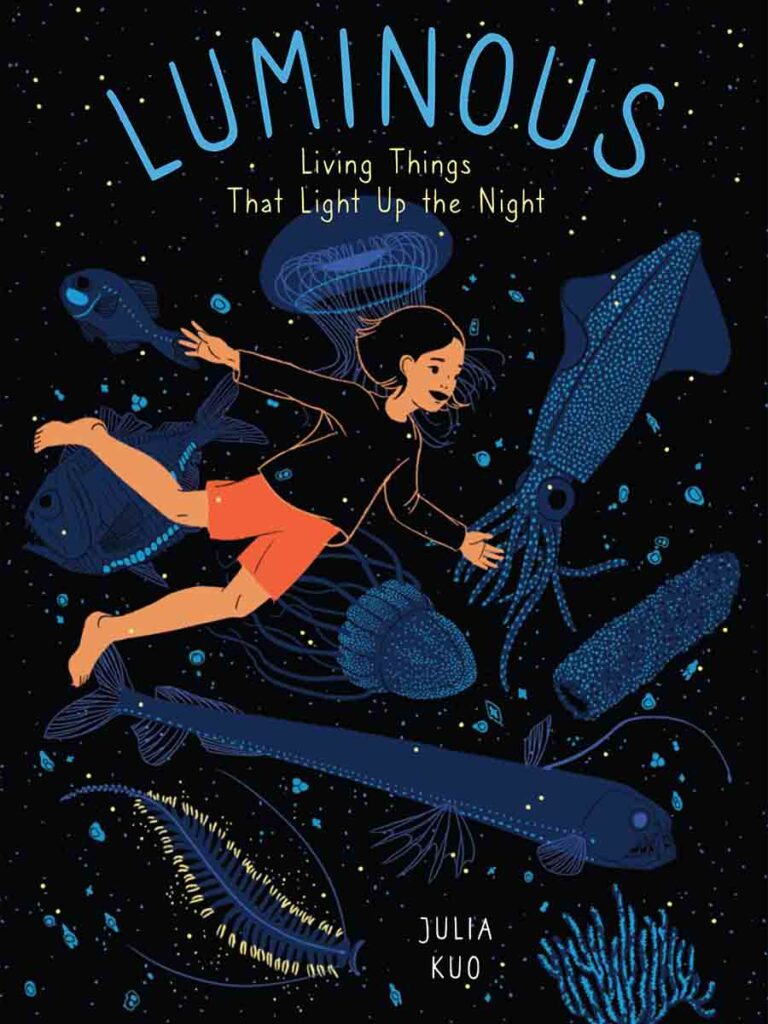
Picture books can serve as important gateways to the scientific wonders of the natural world. A quick glimpse into any picture book on bioluminescence has students wondering if they are, in fact, reading fiction or non-fiction. Derived from the Greek words ”bios” (life) and ”lumen” (light), bioluminescence refers to the ability of living organisms to produce their own light. This phenomenon is often referred to as a form of “living light.”
Bioluminescence is a fascinating subject that offers students a glimpse into an almost magical world lurking just beyond their reach. Many deep-sea marine animals, insects, and even some fungi can produce their own light. In Kuo’s beautifully self-illustrated book, Luminous, students are not only introduced to the magical world of bioluminescence, but light is shed on the diverse reasons why certain creatures illuminate the darkness. We learn that communication, camouflage, and hunting are just a few ways that organisms use their living light.
Using Picture Books to Explore Scientific Concepts
Using picture books to help students understand scientific concepts offers a range of benefits, including:
- Visual Engagement: Picture books provide visual aids that engage students and make complex scientific concepts more accessible. Colorful illustrations and diagrams enhance understanding and capture students’ attention.
- Vocabulary Development: Picture books expose students to scientific vocabulary in a way that is meaningful and easy to grasp. This helps to build a foundation for scientific language and terminology.
- Concept Reinforcement: The combination of text and visuals helps reinforce scientific concepts, making it easier for students to comprehend and remember them.
- Early Exposure to Science: Picture books can cultivate an early interest in science. This early exposure could positively impact the need for more diverse representation in the sciences.
Pairing scientific exploration with a picture book read aloud and a hands-on activity that illustrates the concepts is a fun way to transform the classroom into a place of curiosity and wonder.
Materials Preparation:
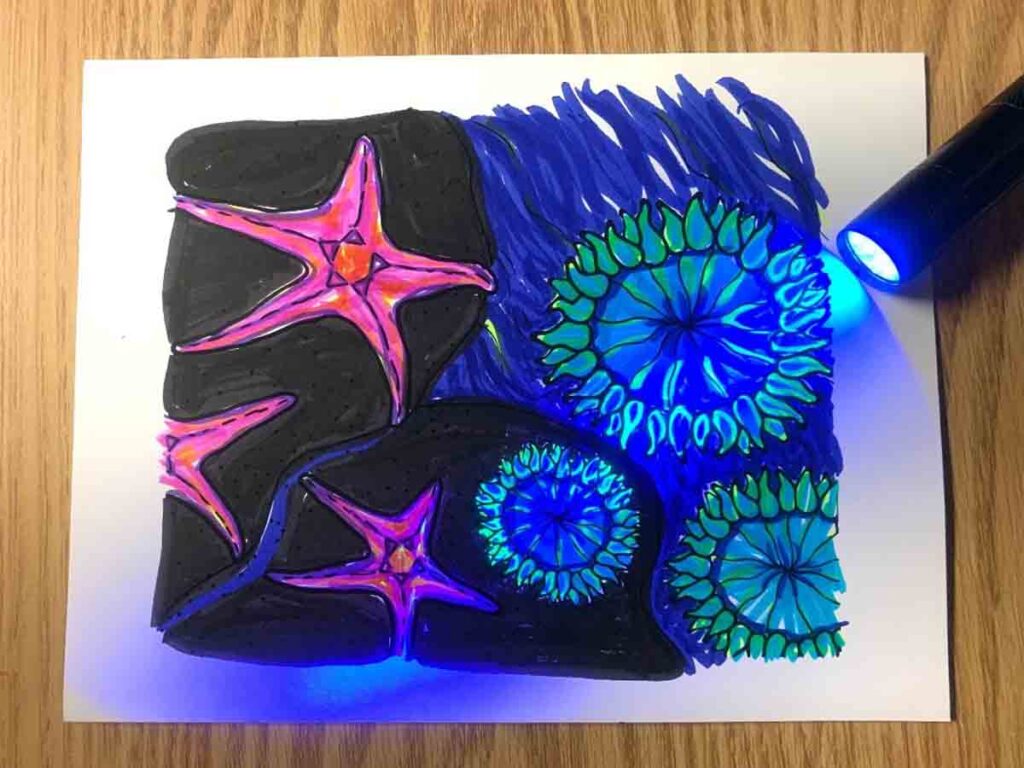
Before the lesson, print out the anemone coloring page on cardstock and make sure you have enough highlighters for all of your students.
Procedure:
- Discussion
- Show students the UV flashlight and ask them what they think it is used for.
- Discuss how UV flashlights help humans see things that we cannot see with our eyes alone.
- Read the book Luminous, by Julia Kuo.
- Discuss ways in which organisms use bioluminescence.
- Show students the UV flashlight and ask them what they think it is used for.
- Activity
- Model the activity before walking students through the steps.
- Each student will receive a piece of cardstock paper with an anemone coloring page printed on it and a yellow highlighter.
- Have students add highlighters to the coloring sheet by filling in sections, outlining lines, and adding non-representation patterns (stripes, waves, dots). It may be helpful to wait to hand out markers, until after students have finished coloring with the highlighter.
- Walk around the room with a UV flashlight and show students how the highlighter is lighting up under the UV light waves.
- Have students add color to the remaining white spots.
- It is okay to cover the highlighter with lighter colors, but darker colors will block out the UV light waves.
- If students outlined shapes, advise them to color up to the line, it is ok to cover the line slightly.
- Continue to walk around testing students’ work with the flashlight as they work.
- Hand out keychain UV flashlights and turn off the lights in the room. Let students observe their wonderful bioluminescent creations!
Additional Resources:
Bioluminescence (nationalgeographic.org)
Bioluminescence | Smithsonian Ocean (si.edu)
Happy Reading!