

How to Make Science Actually Fun (It Involves Worms!)
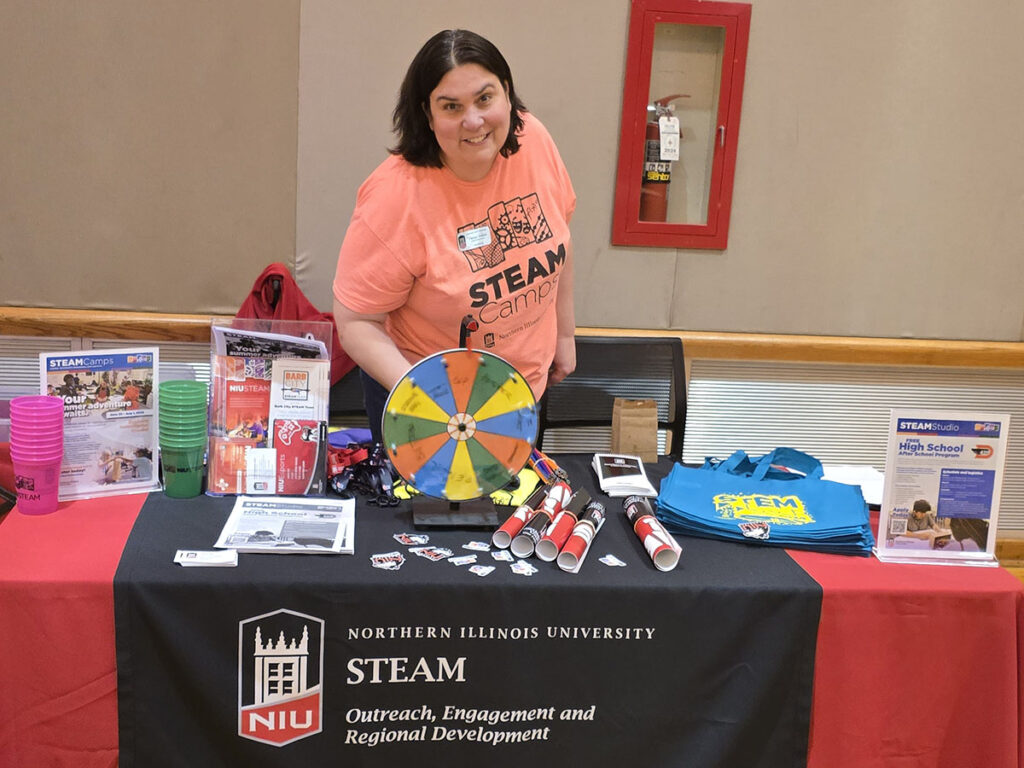
If you’ve ever thought, “Science just isn’t for me,” Chrissy Swartz is here to prove you wrong. In this episode of STEAM Spotlight, the NIU STEAM educator—who’s taught everything from forensics to meteorology—breaks down why so many of us grow up believing we “can’t science”… and how to flip that script for the next generation.
The Problem with Science Class (And How to Fix It)
Chrissy doesn’t hold back: Traditional science education often fails kids by making the subject feel like a rigid set of facts to memorize, rather than a way to explore the world. “Earth sciences get dumped on,” she admits. “They’re where we stick kids who ‘can’t science’ or have run out of electives.” But here’s the irony—earth science (think weather, geology, ecology) is the ultimate STEAM discipline. It blends biology, chemistry, physics and math into real-world phenomena—like why some clouds rain and others don’t, or how rocks tell stories older than dinosaurs.
Chrissy’s solution? Ditch the formulas-first approach. Instead, start with curiosity. When students ask, “Why is that flower purple?” or “Why did the river flood?”—that’s science in action.
Field Trips > Flashcards
One of Chrissy’s golden teaching moments happened at a wastewater treatment plant. Standing in front of a tank bubbling with oxygen, she asked her students, “Who wants to go swimming?” (Spoiler: No one should.) That led to a lively debate about density, buoyancy, and why you’d sink in hyper-oxygenated water—no textbook required.
“That’s the thing about informal learning,” she says. “You can take a concept that feels abstract in a classroom and show it happening in real time.” Whether it’s watching photosynthesis unfold in a lab or designing assistive technology for a community project, the goal is the same: Make science matter to the kids in front of you.
“Everybody Can Science” (Yes, Even You)
Chrissy’s biggest mission? Erasing the idea that science belongs only to people in lab coats. “When a kid walks down the street and wonders about a cloud or a bug, they’re being a scientist,” she says. The trick is nurturing that instinct before they get intimidated by jargon or grades.
Her after-school programs focus on open-ended exploration, not right answers. When students struggled with an engineering challenge recently, they didn’t shut down—they asked for feedback to improve their next prototype. “That’s the design cycle in real life,” Chrissy laughs. “No answer keys, just problem-solving.”
At its core, Chrissy’s philosophy is simple: Science isn’t a subject. It’s a way of seeing the world. And whether you’re a parent, teacher, or just someone who’s ever felt “bad at science,” this episode might just change your mind.
Listen to the full conversation—and prepare to look at clouds (and kids) differently.