

Designing Centers with Narrative Non-Fiction
By Stephanie Dietrich
| Time Required: 45 Minutes | Materials Required: iPads or Chromebooks |
| Grade(s): 3rd-4th Grade | Supplies: Center Directions, Building Supplies, Pencils, Coloring Materials |
“Like any great inventor, Josephine Garis Cochrane identified a problem and created something to solve it. But unlike most well-known inventors at the time, she was female. Born on March 8, 1839, Josephine came into a world that offered few rights or opportunities for women.” – Kate Hannigan
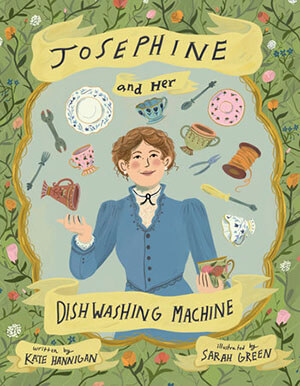
Last month, the Illinois Reading Council (IRC) released their selections for the 2024 ”Illinois Reads” program. Every year, the committee selects six books in six different grade bands, from birth to adult. What makes this list unique is that all of the authors are from Illinois. There are many great books on the list that I will be highlighting this year in the blog. But first, I will be highlighting a book by frequent IRC selection author, Kate Hannigan.
Joseph Cochrane, the inventor of the dishwasher, comes to life in Kate Hannigan’s latest book: Josephine and her Dishwashing Machine. This remarkable story about a woman who, despite barriers, is able to accomplish the remarkable, will inspire students to embrace a fail-forward mindset, seeing setbacks as vital stepping stones to success. Hannigan seamlessly weaves together Science, Technology, Engineering, Art, and Math helping students to see STEAM in our everyday lives. Hannigan’s text is a great launching point for discussions around inventions, engineering design and inventor traits, such as perseverance and creativity.
Designing Centers around Narrative Non-Fiction
Using narrative non-fiction text as the foundation for designing classroom centers is a great way to allow students to take a deeper dive into the subject matter of the text. It also allows the teacher to teach targeted skills to a small group while the other students are engaged in self-directed, engaging activities. When designing the activities, I usually start with the one that I will need to facilitate with students. This could be an introduction to a new website or application or teaching an inquiry or research skill. Then I design activities that will allow students to be engaged in more creative activities that build important social emotional skills. For Josephine and Her Dishwashing Machine, I chose the following activities:
- Researching Notable Women Inventors – Hannigan provided an amazing list of women inventors in the back matter of the book. For this center, students will select one of the listed inventors to research and complete a presentation on. At this center, the teacher can facilitate how to utilize on-line and print sources to obtain information, how to evaluate information and how to cite your sources.
- Engineering Design Challenge – In the book, Josephine uses the design cycle to invent and build a dishwasher. In this building challenge, students will work as a team to build a model of a dishwasher using available materials to hold a cut out of a cup, plate, and fork.
- Creative Writing – In 1893, Josephine takes her dishwashing machine to the World’s Fair in Chicago to exhibit it. Have students write a journal entry from Josephine’s point-of-view the night before the exhibition.
- Inventor’s Challenge – In teams, task students to identify a common household chore they would like to make easier for themselves or someone else in their lives. They will create an invention and then make a poster to market their invention.
Materials Preparation
Before the lesson, divide your students into groups. They will move in groups around the centers. It’s helpful to make a master slide, with each group noted at a center, that can be displayed. Print out your direction materials and set up each station. For the engineering design station, make sure to have cardboard, tape, glue, cups, straws, scissors, plastic materials, and coloring materials. Print out page 5 of Josephine’s patent to show students or insert in your PowerPoint presentation.
Procedure
- Show students the image of Josephine’s patent and invite them to brainstorm what this could be an illustration of.
- Explain that this is a patent for a dishwasher.
- Have a conversation around what a patent is and how it gives credit to inventors, so other people don’t steal their ideas.
- Read Josephine and her Dishwashing Machine. Have a discussion about the characteristics of inventors. Ask students for examples of Josephine’s inventor traits. Ex: When she failed, she didn’t give up.
- On your display, go to Google Patents and type in the number for Josephine’s Patent: US355139. Show students Josephine’s Patent.
- Divide students into groups of 4-6.
- Explain the centers activities and show student groups where they will be assigned for the first round of activities.
- Explain how students can ask for help. Since you will be working with the research group, you may want to use an “ask 3 before me” rule. This can also help build communication and collaboration skills with students.
- Explain to students what a completed activity looks like for each center.
- Have fun!
Assessment
Each center will have its own assessment.
Additional Resources
There are many different extension activities you could do with this book, including discussions and activities around primary sources. The World’s Fair is a fascinating subject and there are many digital exhibits available to show kids. Here are just a few to get you started:
Children’s admission ticket, World’s Columbian Exposition, 1893 | World’s Fair Treasury (umd.edu)
Happy Reading!