

Tips and Tools for Effective Communication – Especially in Difficult and Stressful Situations
By Judith Dymond, Ed.D., STEAM Educator and Director of Development
Last holiday season, Brian Smith, Director of NIU Employee Assistance Program and a licensed social worker, talked at one of our STEM Cafés about holiday stress. Below are a few of his suggestions for navigating the stress the holiday season can bring out.

The holidays can be a stressful time, but understanding emotions and biases can help us successfully navigate conversations and increase positive interactions. With some minor changes, we can navigate these situations with our families and friends.
- Consider for a moment some positive recollections and connections you have with the holidays. As humans, we all seek safety and connection. As we approach interactions with others, we can focus our attention on how we can create the environment that we want to share with others.
- What are some of the potentially unhappy or negative experiences that you may anticipate for these upcoming holidays? It is natural that we might anticipate or pre-plan for potentially challenging conversations or interactions. Sometimes it can help if we prepare a simple statement to redirect unwanted conversations and set a boundary with others.
- “Everything that irritates us about others can lead us to an understanding of ourselves.” Carl Jung. Our own self-awareness is another way to better enjoy holiday experiences. Knowing what is important to us, why it is important, with whom it is important, and sticking to our non-negotiable needs increases the possibilities for better holiday experiences.
- Think before you speak.
- Understand and respond to our emotions, recognizing and challenging our thoughts and expectations of ourselves and others. We can only truly manage ourselves, our emotions, and our own reactions. When we recognize and honor where our power and boundaries lie in each interaction then we are more likely to be the best versions of ourselves.
- Cope in the moment: Mindfulness is a type of meditation in which you focus on being intensely aware of what you’re sensing and feeling in the moment. There are many mindfulness measures that you can employ. If you are not familiar with it, try looking up the 5-4-3-2-1 Grounding Technique and consider using it if needed. The best way to manage our own emotions and reactions is to be able to know ourselves and our reactions.
- Be a good listener. Listen to what others are saying, give what we would like to get in response, and think how you can respond positively.
- Think about what you want to get out of the situation/engagement with others. What are your goals for this engagement?
- When you consider what you need this holiday season, what are your non-negotiables?
- What are five things that you want to do and with whom do you want to do them?
- What do you need to do or experience most?
- Self-care is essential.
- Acknowledge that we may have a bias on the topic. Be sure to adjust your own mask before helping others.
- Don’t dump your emotions on each other.
- Don’t own someone else’s stuff.
- Remember we all communicate differently.
- Discuss with your family your needs and goals and listen to their own. This opens a dialogue and lessens the chance of hurt feelings or misunderstanding.
- Practice what you might say at the event in case some of the anticipated topics come up. Prepare to speak up.
- Choose the best space and time to communicate your message.
- Set boundaries for ourselves. Know what you are capable of.
- Speak up in a calm, simple, and direct way.
- Recognize where our healthy power is to maximize connections with others.
- Throw kindness around like confetti!
In summary, here are 6 easy tips for reducing holiday stress.
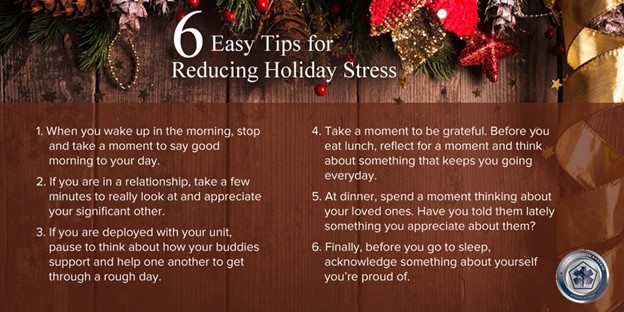
These tips should help us understand and respond to our emotions, recognizing and challenging our thoughts and expectations of ourselves and others, setting boundaries, and recognizing where our healthy power is to maximize connections with others. We can de-escalate potentially difficult conversations while increasing positive interactions and experiences with others during the holidays.