

Catch a bug? Or learn how to stay healthy by building a bug!
By Stephanie Dietrich and Newt Likier, NIU STEAM educators
During the time we all spent in quarantine, there was a pretty big focus on hygiene. The CDC recommended humming happy birthday twice while handwashing to make sure twenty seconds transpired, and there were pictures and videos of the correct way to scrub between all your fingers. While we aren’t in quarantine any longer, there’s still a great reason to keep the soap and water flowing. To celebrate National Handwashing week, we wanted to share a lesson on a related topic: how do viruses mutate and why is there a different vaccine every year?
At Barb City STEAM Team, our afterschool program for middle school students in DeKalb, we recently had a focus on biology and viruses. NIU practicum student Abby Singer guided learners through understanding how a virus sneaks into our body and then attempts to infect us. Most of the time, our immune systems kick in fast and hard, dealing with the threat quickly. But as our learners discovered, viruses can change form and disguise themselves in order to work their way through our defenses. To help our students learn about how a virus can mutate and invade a cell, they were challenged to build their own “bug”. They then had to pilot their virus through a maze and try to infect a healthy cell.
For this activity, the students needed: several balloons, a plastic cup, straws, toothpicks, some hot glue and decorations. The goal was to build a virus with the cup as the base, and then navigate that virus into a balloon to pop it. The students also used Sphero robots – mini ball-shaped robots that could sit under the cup and move their “virus” around.
At first, the balloon was unguarded and easy to attack. But, after each attempt, we made the balloon harder to reach or harder to pop. Some things we tried were moving the balloon farther away or giving the balloon some form of armor (like with paper or cotton balls). These modeled the immune system’s protective response.
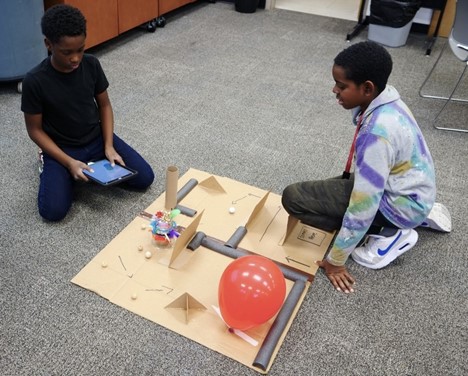
Our learners used Sphero robots to move their viruses to attack the balloon, but if you’d like to try this at home, you could use any kind of robot or remote-controlled toy. Can you think of anything you could use at home to make your virus mobile? After each attempt, reevaluate your virus and try to make your build more effective or efficient.
This activity may give you a clue as to why the flu vaccine changes every year. There isn’t just one flu virus, but several. Each year, scientists spend a lot of time and effort on trying to figure out which strain (or version) of the flu is going to be the most prevalent that year. Once they have a good guess, the vaccine for that year is specific to their guess. A lot of our vaccinations are effective for a long period of time, like the Tdap vaccine, which you only need to get every ten years. Unlike the flu, there aren’t a ton of different strains of the illnesses that vaccine protects you from.
Other than getting your yearly flu shot, the best protection you can practice is hand washing. We may not be in quarantine anymore, but that’s no reason to stop humming a little song, scrubbing between your fingers, and washing away all the germs we pick up from the world around us every day!