
Spooky Science
By Jeremy Benson, NIU STEAM Educator
October is synonymous with changing leaves, pumpkin spice, apple cider, Halloween and – for us – the Haunted Lab!
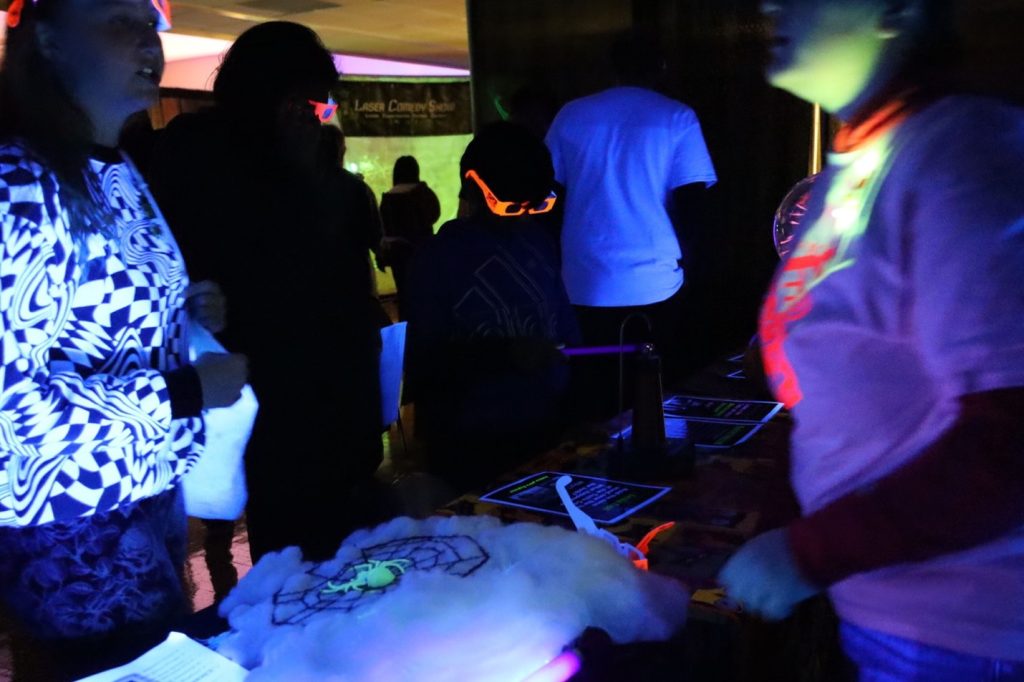
If you’re new to NIU STEAM, you might not know that our Haunted Lab was the original event that eventually grew into our annual STEM Fest celebration. More than a decade ago, our Haunted Physics Lab event became so popular it outgrew its space, and in 2010 STEM Fest was born. Many of our Haunted Lab exhibits have been created and built by our own staff and are designed to demonstrate physics phenomena using “spooky” or mysterious applications.
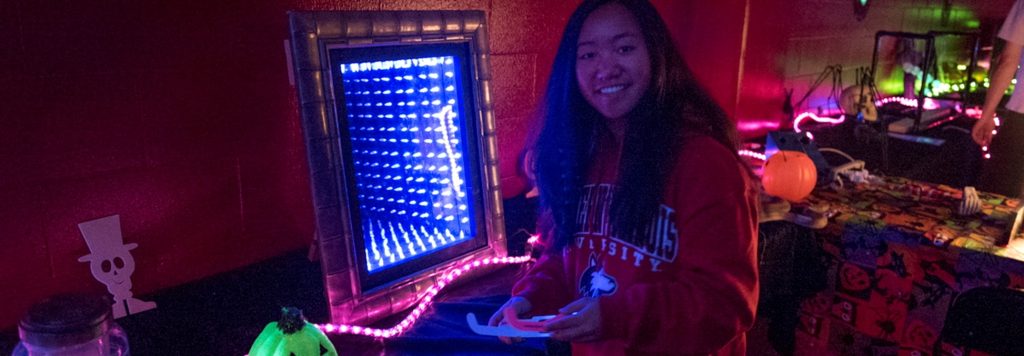
One of the earliest exhibits we created is our own version of an Infinity Mirror. The infinity mirror uses a string of LED lights sandwiched between reflective panes of glass to create the illusion of an infinitely repeating series of lights.
Many of our laser-based displays were constructed as part of the celebration for the 50th anniversary of the laser, which took place in 2010. Our popular laser spirograph is just one example. This exhibit works by aiming a laser at a pair of rotating mirrors. The mirrors spin the laser’s dot into circles and loops reminiscent of old-fashioned spirograph toys. Changing the speed of the two mirrors changes the patterns they create.
Other displays highlight the science behind common Halloween displays such as high voltage electricity, holograms and black lights with glowing bugs.
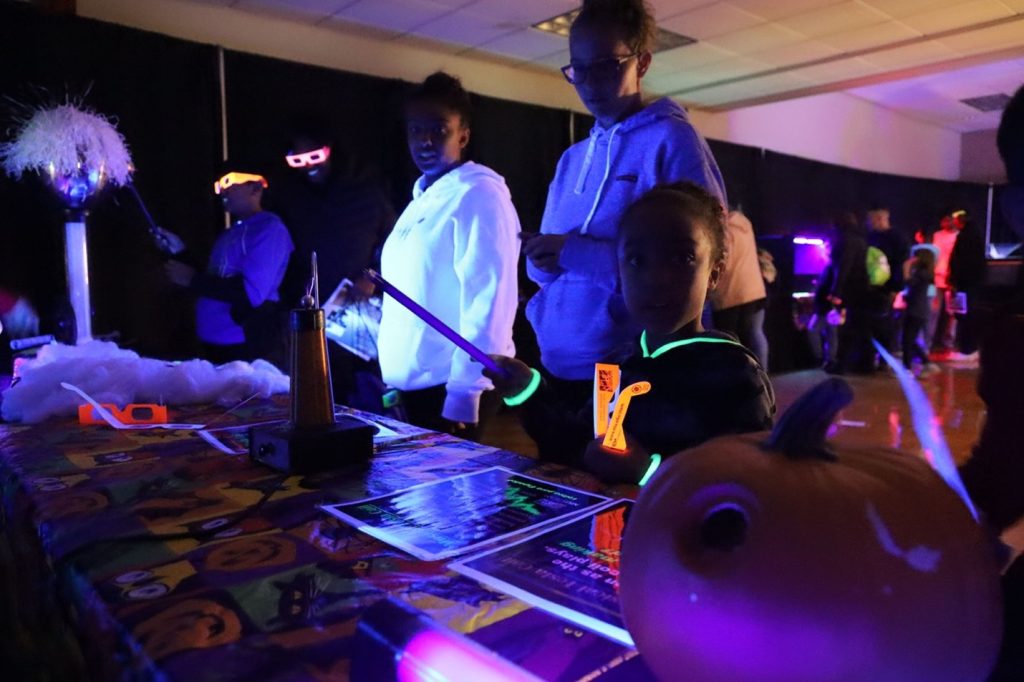
Black lights and glowing bugs: DO try this at home!
This is one of our favorite experiments that’s easy to try at home. Glow in the dark items need to be charged using light before they’ll glow. But not all colors of light are as effective. Glow in the dark items react most strongly to violet and ultra-violet light, just like the light given off by a black-light. So if you use a black light to charge your glow-in-the-dark items, they’ll glow longer and brighter than with regular white light.
Here’s how you might experiment with this at home.
- Gather glow-in-the dark clothing, toys or other items you have on hand.
- Try charging an item with sunlight, an overhead light in your home or a common lamp.
- Turn off the lights, watch and record your observations! How long did the item glow? How bright did it seem to you?
- Try charging the same item, this time with a black light.
- Turn off the lights, watch and record your observations again. Did the item glow more or less brightly, and for how long?
- Try this out with various items and types of light. See what patterns you can notice!